LinkedIn's New 'Seems Like AI Slop' Button Puts Your Career Behind an AI Detection Guess
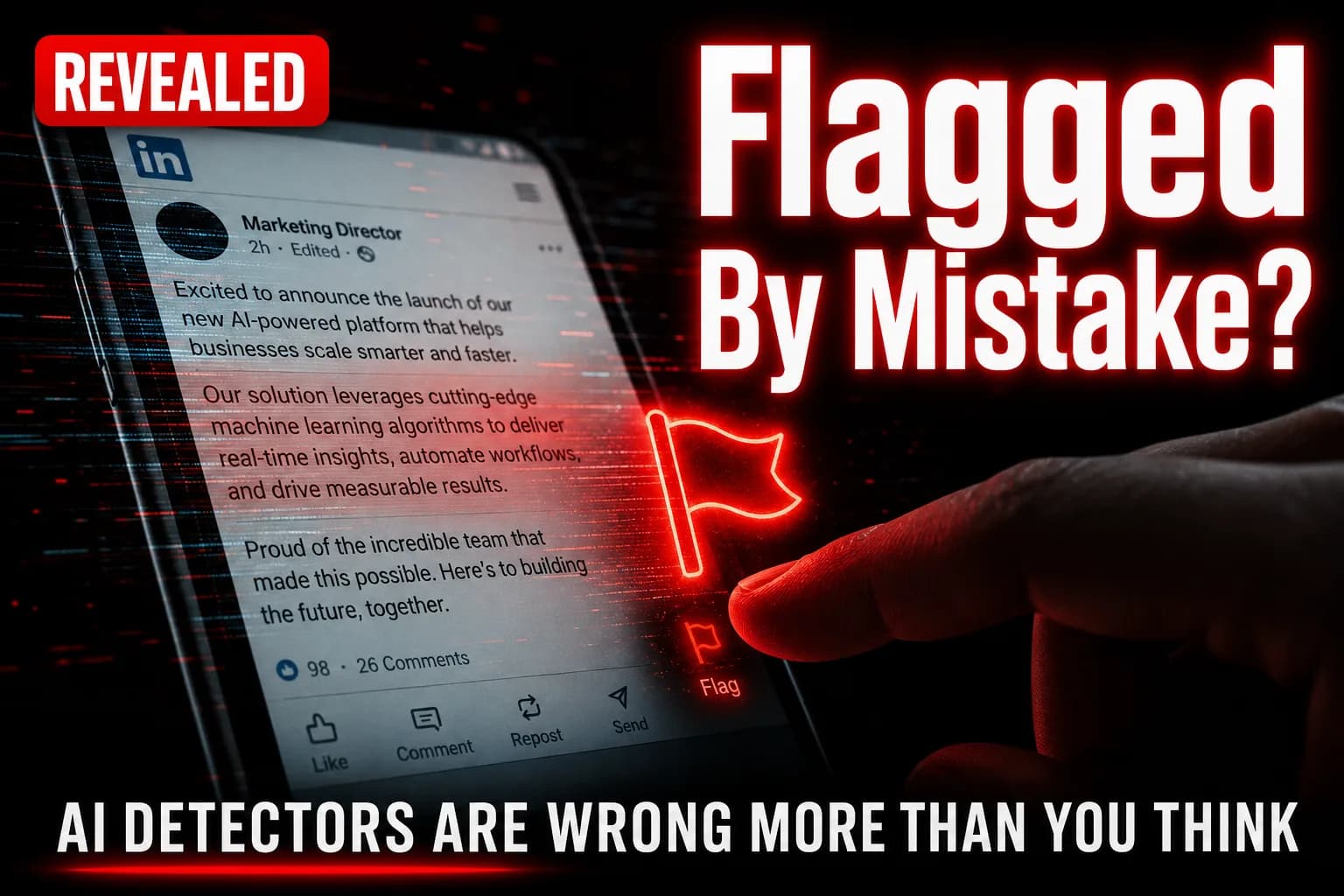
LinkedIn now lets users click a button that flags a post as "seems like AI," and the company confirmed the feature is rolling out as part of a broader push against automated content, according to Campaign India's report on the change. This is not a content warning label appearing under suspect posts. It's a crowd-triggered flag system feeding into LinkedIn's own ai detection infrastructure, and it puts every professional who uses ChatGPT to draft a caption inside a system with a documented false-positive problem.
The mechanics matter here. A user sees a post, believes it reads like AI-generated filler, and clicks the button. That signal presumably feeds a review pipeline — LinkedIn hasn't published the exact scoring or enforcement thresholds. What the company has confirmed is the intent: reduce the volume of low-effort, AI-generated posts cluttering the feed, a complaint that's been building on the platform for over a year as "AI slop" became shorthand for engagement-bait carousels and generic thought-leadership paragraphs.
Who Actually Gains From This AI Detection Push
LinkedIn gains the most, directly. Feed quality complaints hit engagement metrics, and engagement metrics hit ad revenue — the platform's core business model since Microsoft folded it into its enterprise cloud strategy. A visible enforcement mechanism, even an imperfect one, signals to advertisers and power users that the platform is managing the AI content flood rather than ignoring it.
Human, idiosyncratic writers gain next. Posts with specific numbers, personal anecdotes, and irregular phrasing tend to score lower on most AI-detection tools than polished, evenly-paced corporate prose — which means writers with a rougher, more particular voice are structurally less likely to get flagged. That's a real advantage for people who already write like themselves instead of like a template.
Recruiters and talent teams gain a filtering signal, even an unreliable one. If flagged content correlates even loosely with low-effort job applications or engagement farming, that's a small but real hiring-funnel benefit for teams drowning in AI-assisted cover letters and posts.
Who Loses When AI Detection Gets This Public
Non-native English speakers lose disproportionately. Multiple peer-reviewed studies — including a 2023 Stanford analysis published in Patterns — found that AI-detection tools misclassified TOEFL essays written by non-native English speakers as AI-generated at rates as high as 61%, because those detectors key on sentence-length uniformity and vocabulary predictability that also show up in non-native fluency patterns. If LinkedIn's system inherits similar biases, that population takes the reputational hit first.
People who use AI tools for grammar cleanup, not ghostwriting, lose next. Running a paragraph through Grammarly's AI-powered suggestions or asking ChatGPT to tighten a draft is now functionally indistinguishable, to most detectors, from generating the whole post with AI. There's no granular distinction between "AI helped me edit" and "AI wrote this," which means legitimate editing assistance carries the same flag risk as full automation.
Small creators and freelancers lose disproportionately versus verified brands and public figures, who get more benefit of the doubt and more human moderation attention when disputes arise. A flag on a Fortune 500 comms account gets reviewed. A flag on a freelance consultant's post may just sit there, uncontested, shaping how the algorithm treats future reach.
 hand clicking flag button interface.
How Accurate Are AI Detectors, Actually
This is the part worth sitting with before panicking about your own posts. OpenAI shut down its own AI-text classifier in 2023 after just six months, citing a "low rate of accuracy." The tool that was supposed to detect ChatGPT output couldn't reliably detect ChatGPT output — built by the company that made the model in question.
Turnitin's AI detector, widely deployed across universities, has published a self-reported false-positive rate around 4% at the sentence level, which sounds low until you scale it: a 4% false-positive rate across a platform with more than 1 billion members posting daily means a large absolute number of misflagged humans, even if the percentage looks small on a slide. GPTZero and similar third-party tools have shown accuracy swings depending on topic, length, and formatting, with shorter posts — the exact format LinkedIn favors — being harder to classify reliably than long-form essays.
LinkedIn hasn't published its own detector's accuracy rate. That's the actual story here, more than the button itself: a platform is deploying an enforcement-adjacent feature built on a technology category that has a well-documented, multi-year track record of unreliability, without disclosing its own error rate.
The Strongest Case Against Worrying About This
The counterargument deserves real weight: this is a user-reported flag, not an automated ban, and LinkedIn has not confirmed any algorithmic downranking tied directly to flag counts. Campaign India's report describes a detection button, not a documented shadowbanning policy with measurable reach penalties. Comparing this to Turnitin's academic enforcement, where a flagged essay can mean an actual grade penalty or expulsion hearing, may overstate the stakes.
It's also true that platforms have run crowd-flagging systems for years — Community Notes on X, spam reports on Facebook — without those systems producing mass reputational collapse for flagged users. Most flags likely get absorbed into a review queue that either does nothing or results in a minor reach adjustment, not a visible scarlet letter on a profile.
That argument holds up, partially. But it undersells the compounding effect: even a soft, unconfirmed reach penalty matters enormously for people whose LinkedIn visibility is directly tied to client acquisition, hiring, or personal brand income. A 15% reach reduction that never gets explained or contested is still a 15% reach reduction. The absence of transparency around consequences is itself the risk, not just the accuracy of the detector.
 split screen human AI writing.
What Actually Triggers a False Positive
Detector research consistently points to a handful of patterns that read as "AI" regardless of who wrote them. Even, low-variance sentence length is the biggest one — the Stanford Patterns study specifically flagged this as the mechanism behind non-native speaker misclassification. Heavy use of transitional phrases like "moreover" and "furthermore," oddly formal tone in casual contexts, and a lack of first-person anecdote all push a post toward "AI-sounding" in most classifier architectures.
Ironically, the posts most likely to get flagged are often the ones written by careful, formally-trained writers — not the low-effort AI slop the button was built to catch. A native AI-generated post dressed up with a personal anecdote inserted afterward can slip past the same system that flags a genuinely human, meticulously edited paragraph.
What To Do If You Post On LinkedIn Regularly
- Break sentence-length uniformity deliberately. Mix short, punchy lines with longer ones — this is the single strongest documented signal against false-flagging based on current detector research.
- Keep specific, checkable details in every post. Names, dates, numbers, and personal anecdotes are harder for classifiers to associate with generic AI output than abstract statements.
- Avoid heavy transitional-phrase density. Cut "moreover," "furthermore," and "in today's environment" — these are exactly the phrases detector training sets over-associate with generated text.
- Screenshot and save your drafts. If you're ever flagged, having a visible edit history or draft trail is the most concrete evidence you can offer in an appeal.
- Watch your reach metrics after any flag, if you learn of one. A quiet dip in impressions without explanation is the practical signal to track, since LinkedIn hasn't confirmed how flags map to distribution.
Frequently Asked Questions
Does LinkedIn's AI detection button actually reduce my post's reach?
LinkedIn has not confirmed that a flag automatically triggers reduced distribution. The company has only confirmed the feature's existence as part of an anti-automation push, not the specific downstream consequences of being flagged.
Can AI detection tools reliably tell human writing from AI writing?
Not consistently. OpenAI discontinued its own classifier in 2023 for low accuracy, and independent research has found detectors misclassify non-native English writing as AI-generated at rates up to 61% in some studies.
What kind of writing is most likely to get falsely flagged as AI?
Uniform sentence length, heavy use of formal transitional phrases, and a lack of specific personal detail are the strongest documented triggers — patterns common in both AI output and careful, formal human writing.
Related Articles
Benedict Evans Says Most Enterprise AI Spend Is Wasted — Here's What Actually Works

How To Disable AI Mode On Google (And Stop Overpaying On Search)
Ed Zitron Called the AI Bubble Two Years Ago. Dan Luu Just Checked His Math.