EFF Tells Courts: Stop Rewriting Copyright Law Because AI Is Trendy
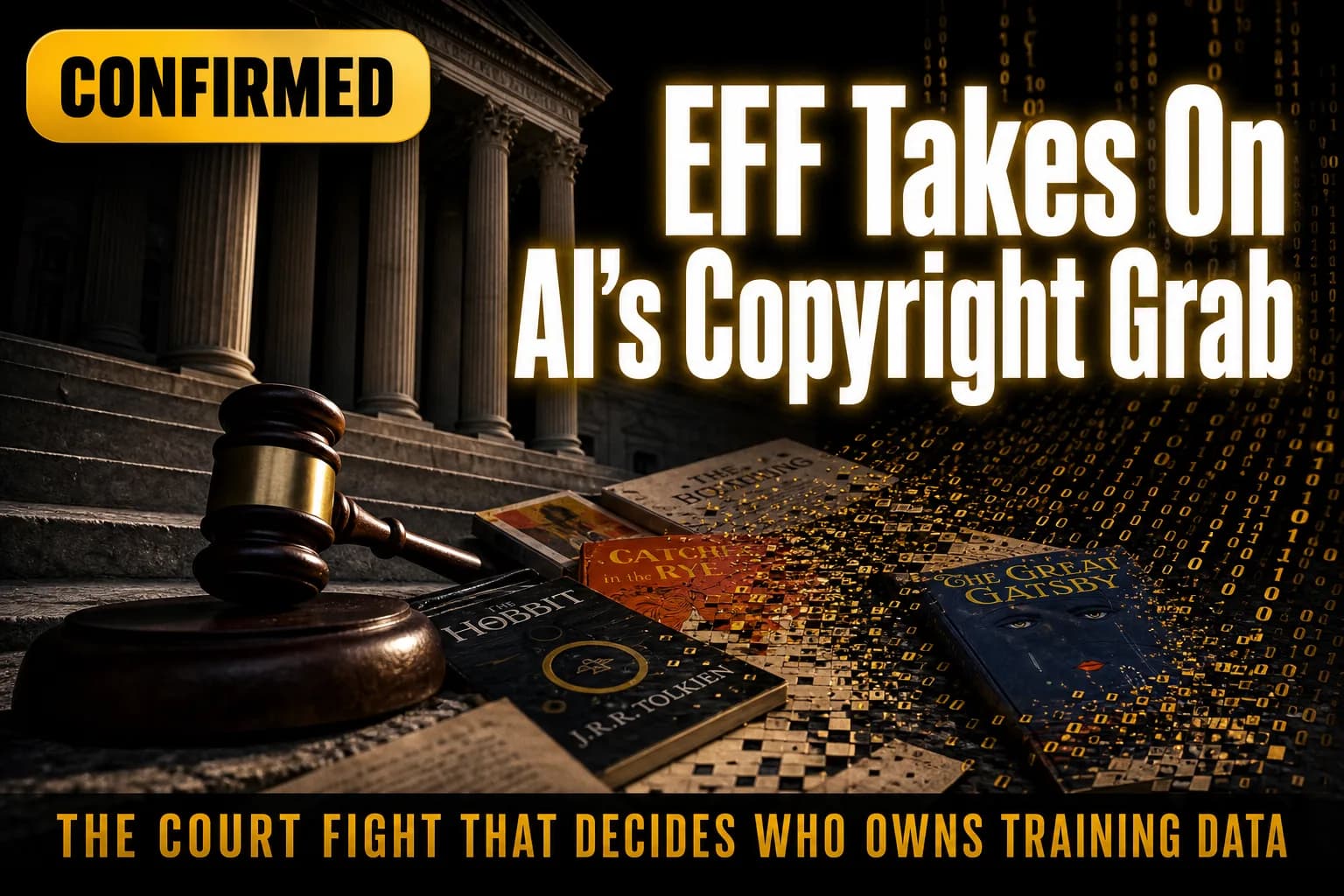
The Electronic Frontier Foundation told federal courts something that should not need saying: copyright law does not get suspended because a technology is popular.
That's the core of EFF's recent filings, which push back against a legal theory circulating through multiple AI copyright cases — the idea that training large language models on copyrighted material deserves a fair-use exemption broader than anything granted to search engines, archives, or previous data-driven technologies. EFF's position, laid out in its August 2026 deeplink post, is procedural and specific: courts should apply existing fair-use doctrine as written, not invent a new category of protection sized to fit the AI industry's business model. The distinction matters because several ongoing cases — including disputes involving OpenAI, Meta, and Stability AI over training data sourced from copyrighted books, code, and images — hinge on whether judges treat "AI training" as functionally identical to prior fair-use precedents like Authors Guild v. Google or whether they carve out new rules because the defendant is an AI company.
This is where the ai hype vs reality gap becomes a legal question with dollar signs attached. If courts adopt an AI-specific fair-use standard, companies that scraped billions of copyrighted works get retroactive legal cover. If courts apply the existing four-factor fair-use test without modification, many of those same companies face liability exposure running into the billions, and future model training becomes contingent on licensing deals rather than open scraping.
What EFF Is Actually Arguing in Court
EFF's filings do not claim AI training is illegal. They argue the opposite risk: that panic-driven or hype-driven rulings could either over-restrict transformative uses that deserve fair-use protection, or under-scrutinize commercial exploitation that doesn't. The organization's consistent position across its amicus briefs is that the four-factor fair-use test — purpose and character of the use, nature of the copyrighted work, amount used, and market effect — already has the flexibility courts need.
The filings specifically warn against two outcomes. One is judges treating "it's AI, and AI is important" as a standalone factor tipping fair use in a defendant's favor, something no other technology sector has been granted. The other is legislatures or courts creating blanket restrictions on machine learning that would also chill search indexing, accessibility tools, and academic text-mining — uses that have survived fair-use scrutiny for two decades.
EFF cites Google Books (2015) and Authors Guild v. HathiTrust (2014) as the operative precedents: both allowed large-scale copying for purposes like search indexing and text analysis, precisely because the courts found the use transformative and the market harm to original authors minimal or speculative. EFF's argument is that AI training should be measured against that same bar — not a lower one, and not a higher one invented for the occasion.
 courtroom gavel legal documents.
Who Gains If Courts Side With EFF's Framing
Authors, visual artists, and independent publishers gain the most direct benefit. Named plaintiffs in parallel litigation — including the Authors Guild's ongoing suit against OpenAI and Sarah Silverman's suit against Meta over the Books3 dataset — are arguing that wholesale ingestion of copyrighted books for commercial model training fails the "market effect" prong of fair use, since AI outputs can substitute for the original works in the marketplace. A ruling applying standard fair-use analysis, rather than a new AI carve-out, strengthens their negotiating position and could force licensing markets into existence where none currently exist.
Smaller AI companies and open-source model developers gain an unexpected benefit too. A licensing-based training regime, while expensive, creates a more predictable compliance path than a legal environment where fair-use boundaries shift case by case based on how sympathetic a company's PR narrative is. Predictability is worth something even when it costs money.
Who Loses If the AI-Specific Exemption Wins
Large AI labs with the deepest pretraining datasets have the most to lose from standard fair-use scrutiny, because they have the most exposure — Common Crawl-derived datasets, Books3, and LAION-5B all contain copyrighted material acquired without licensing negotiations. A ruling that treats this as ordinary infringement analysis, rather than granting AI a special exemption, means these companies face retroactive liability for models already deployed commercially.
Rights holders lose if courts go the other direction and create the AI-specific carve-out EFF is warning against. That outcome would mean copyrighted books, code repositories, and image datasets can be ingested for commercial model training with no compensation mechanism, regardless of whether the resulting models compete with the original creators in the market. This is the ai hype vs reality tension in its starkest form: the industry's argument for special treatment rests on AI's transformative potential, not on any doctrine that other data-intensive industries received.
 scales balancing tech books.
The Strongest Counterargument, and Why It Doesn't Fully Hold
The strongest case against EFF's position is not that AI deserves special treatment — it's that applying 1990s-era fair-use doctrine mechanically to a technology that didn't exist when the precedents were written could produce absurd results in either direction. Fair use has always evolved through case-by-case application to new technology; the VCR ruling in Sony v. Universal (1984) and the Google Books ruling both required courts to reason by analogy because no exact precedent existed. Insisting on rigid precedent-matching, critics argue, risks freezing the law exactly when flexibility is most needed.
This argument has real force, and EFF's own citation of Google Books concedes the point implicitly — that ruling itself extended fair-use doctrine into new territory. But EFF's actual position is narrower than "never adapt the law." It's that adaptation should happen through the existing four-factor analysis applied honestly to AI's specific facts — transformativeness, scale, and market substitution — rather than through a categorical exemption granted because the technology is currently generating enormous market valuations. The four-factor test is the flexible mechanism; EFF's objection is to skipping that analysis in favor of treating "AI" as a magic word that pre-determines the outcome.
Why This Matters More Than the Next Model Release
Readers evaluating whether to build products, workflows, or investments around generative AI tools are making a bet on legal stability that doesn't currently exist. A model trained on data later found to be infringing doesn't just create liability for the company that built it — downstream products built on that model inherit legal uncertainty. Enterprises licensing GPT-based or Stability-based tools for commercial use are already asking vendors for indemnification clauses specifically because this litigation is unresolved.
The ai hype vs reality gap shows up concretely here: marketing narratives describe AI capability as inevitable and unstoppable, while the legal infrastructure underneath that capability is being actively contested in courtrooms right now, with outcomes that could force retraining, delicensing, or shutdown of specific commercial models. No prior legal ruling has forced a major foundation model offline for copyright reasons as of this writing, but the plaintiffs in the Authors Guild and Getty Images v. Stability AI cases are explicitly seeking injunctive relief, not just damages.
 server room data streams.
What Happens Next in These Cases
Multiple cases are moving through discovery and motion practice simultaneously, meaning no single ruling will resolve the fair-use question — but early rulings on motions to dismiss are already shaping which arguments survive. Courts in the Northern District of California and the Southern District of New York are handling parallel cases with potentially divergent outcomes, which increases the odds this issue eventually reaches the Second Circuit, Ninth Circuit, or the Supreme Court for resolution.
- Track motion-to-dismiss rulings in Authors Guild v. OpenAI, Getty Images v. Stability AI, and the Meta Books3 litigation — these early procedural rulings signal which fair-use arguments judges find credible before trial.
- If you're building products on third-party foundation models, request contractual indemnification clauses now rather than after a ruling changes your vendor's liability exposure.
- Read EFF's actual amicus filings rather than secondhand summaries — the deeplink post links directly to filings, and the four-factor analysis is public record, not speculation.
- Watch for legislative activity parallel to the litigation; Congress has held hearings on AI training data but has not passed binding legislation, meaning courts remain the primary venue for now.
Frequently Asked Questions
What is EFF actually asking courts to do?
EFF is asking courts to apply the existing four-factor fair-use test to AI training cases without creating a new legal category specifically for AI companies. Their filings argue this cuts both ways — it prevents blanket AI exemptions but also prevents blanket AI restrictions that would harm unrelated technologies like search indexing.
Does this mean AI training on copyrighted work is illegal?
No court has issued a final ruling establishing that broadly. Multiple cases, including Authors Guild v. OpenAI and Getty Images v. Stability AI, are still in litigation, and outcomes will likely vary by case based on specific facts about data sourcing and market impact.
How does the ai hype vs reality gap show up in this legal fight?
Marketing narratives frame AI capability as inevitable, while the legal foundation for how that capability was built — specifically the training data — remains contested and could result in retraining requirements, licensing costs, or injunctions against specific models.
Who are the named parties in the related lawsuits?
Plaintiffs include the Authors Guild, comedian Sarah Silverman, and Getty Images; defendants include OpenAI, Meta, and Stability AI. EFF is not a party to these suits but has filed amicus briefs arguing against AI-specific fair-use exemptions.
Related Articles
Benedict Evans Says Most Enterprise AI Spend Is Wasted — Here's What Actually Works

How To Disable AI Mode On Google (And Stop Overpaying On Search)
Ed Zitron Called the AI Bubble Two Years Ago. Dan Luu Just Checked His Math.