Ed Zitron Called the AI Bubble Two Years Ago. Dan Luu Just Checked His Math.
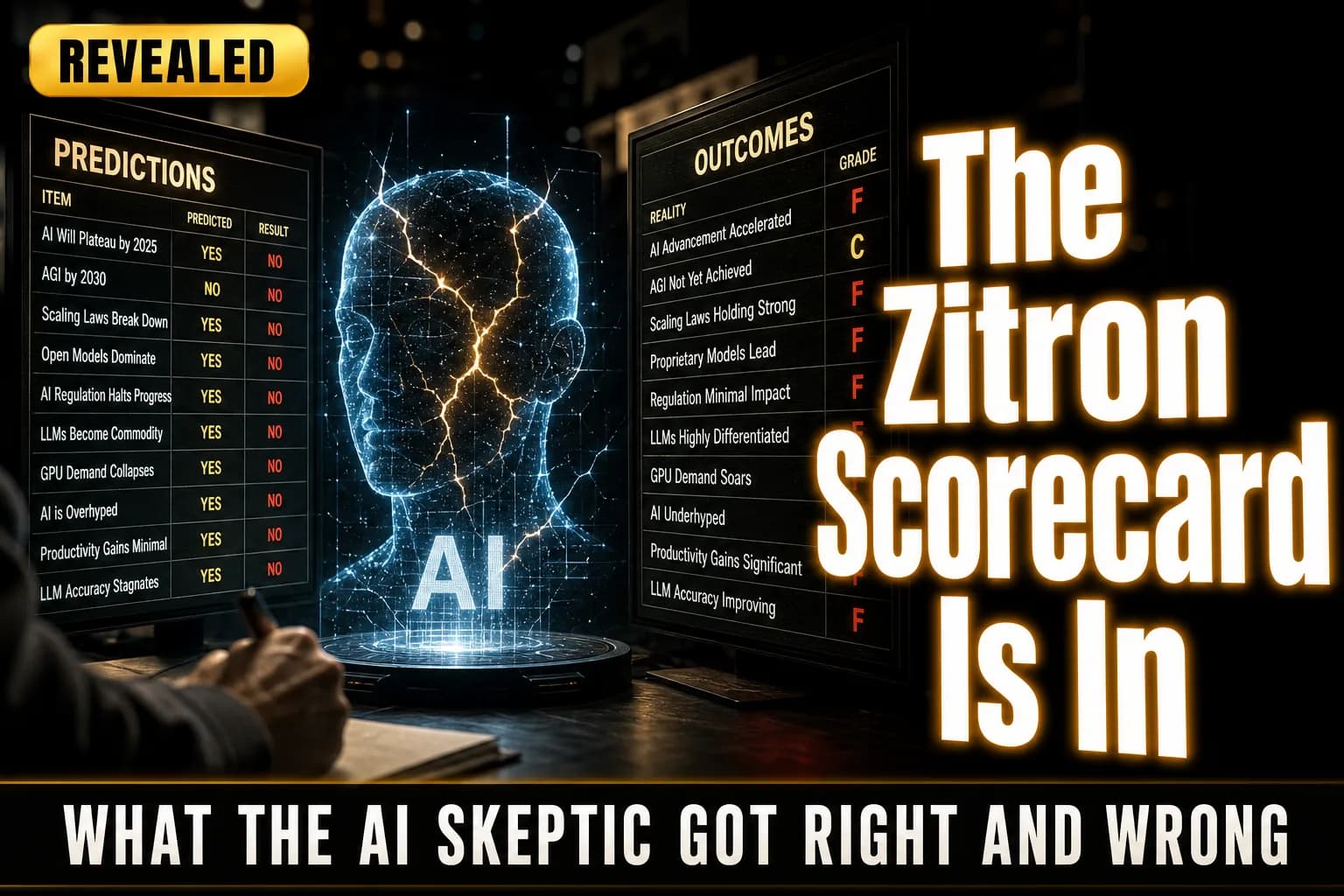
Dan Luu, a widely respected systems engineer known for rigorous, receipts-based writing, spent real time fact-checking two years of Ed Zitron's AI predictions — and the results didn't hand a clean win to either side. That single data point is why a 859-upvote Hacker News thread formed around a personal blog post: this is the first serious, non-tribal attempt to grade the loudest AI skeptic against the loudest AI boosters, using dates and numbers instead of priors.
Ed Zitron runs the newsletter "Where's Your Ed At" and has spent roughly two years arguing that the generative AI industry's spending doesn't map to any plausible revenue path — that OpenAI, Microsoft, and the broader ecosystem are burning capital on a technology that can't monetize at the scale required to justify it. The AI skeptic Ed Zitron framing has made him a recurring villain in industry Twitter and a recurring hero in AI-fatigued corners of tech. Dan Luu's post at danluu.com/zitron doesn't take a side going in — it goes claim by claim.
What Dan Luu Actually Did
Luu's methodology is the reason this piece traveled. Instead of asking "is Zitron right in spirit," he pulled specific, dated, falsifiable predictions from Zitron's archive and checked them against what actually happened in the intervening months. That's a meaningfully different exercise than most AI-discourse content, which tends to cite whichever Zitron line supports the writer's pre-existing take.
The post treats predictions as a ledger. Some claims about unsustainable compute costs and thin enterprise adoption numbers held up well against reporting from outlets covering OpenAI's burn rate and Microsoft's Copilot attach rates. Other claims — particularly ones with hard timelines attached, like specific companies collapsing or specific products getting cancelled by a stated date — didn't land when the date arrived.
That mixed record is the actual finding, and it's more useful than a verdict either way. A skeptic who's right about everything isn't a skeptic, he's an oracle, and nobody credible claims that status for Zitron or anyone else writing about AI economics in real time.
Who Gains From This Fact-Check
Readers skeptical of AI capex headlines gain a citable, non-partisan source for "here's where the bear case actually checks out." Before this post, citing Zitron meant citing a polemicist; citing Luu's audit means citing someone with no financial stake in the outcome grading the polemicist's homework. That's a meaningfully stronger citation in any argument about whether AI spending is rational.
Zitron himself gains credibility on the specific claims that held — his warnings about margin compression in AI-services businesses and about the gap between demo capability and production reliability are among the ones Luu's post finds substantiated by subsequent reporting. Being fact-checked by a rigorous third party and coming out mostly intact is a better outcome for a skeptic's reputation than being uncritically amplified by people who already agreed with him.
Who Loses From This Fact-Check
The AI industry's most triumphalist messaging loses ground here, specifically the claims that profitability was imminent and that enterprise adoption numbers reported in earnings calls reflected durable usage rather than pilot-stage experimentation. Luu's post doesn't argue the technology is worthless — it argues specific optimistic timelines and revenue projections from industry-aligned voices haven't matched outcomes either.
Zitron also loses a little ground on precision. The predictions that named specific dates or specific corporate failures and missed are the ones Luu flags plainly, without softening. That matters for anyone using Zitron as a forecasting tool rather than as a framework — the post is explicit that his hit rate on hard, falsifiable, date-bound claims is weaker than his hit rate on structural, directional claims about unit economics.
 split scoreboard, predictions versus outcomes.
The Strongest Case Against This Whole Framing
The best objection to treating this as a "who's right" scorecard is that grading pundits on discrete predictions rewards vagueness. A forecaster who says "this is unsustainable" without a date can always claim vindication eventually, because "unsustainable" has no expiration. Zitron's structural claims about compute costs outrunning revenue are exactly this kind of durable-but-unfalsifiable statement, and a critic could argue Luu's post gives him too much credit for directional correctness that was never actually at risk of being wrong on any specific timeline.
That objection has real teeth, and it's worth taking seriously rather than waving off. But Luu's post addresses it implicitly by separating claim types rather than averaging them into one score. He treats "OpenAI's inference costs will keep pressuring margins" as a different category of claim than "Company X will shut down its AI product by Q3," and grades each category on its own terms. The fair reading isn't "Zitron is right" or "Zitron is wrong" — it's that his structural economic critique has held up better than his event-level forecasting, which is a genuinely informative distinction if you're trying to decide how much weight to put on his next newsletter.
Why This Matters Beyond One Newsletter Feud
The reason 859 people upvoted a fact-check of a Substack writer isn't affection for either Zitron or Luu. It's that AI investment decisions — corporate budget allocations, personal career bets, retail investor exposure to Nvidia and Microsoft — are increasingly being made on the basis of confident public claims from people with financial incentives pointing in one direction. A rigorous third party auditing those claims against outcomes is rare enough to be newsworthy on its own.
 newsletter feed and financial charts.
Most AI coverage falls into one of two failure modes: uncritical amplification of vendor claims, or uncritical amplification of skeptic claims, depending on the outlet's audience. Luu's post is notable precisely because it refuses both modes and instead does the unglamorous work of checking dates against outcomes. That's the differentiator that made it travel on Hacker News rather than just among Zitron's existing subscriber base.
What This Means For How You Read the Next AI Hype Cycle
The practical takeaway isn't "trust Zitron" or "distrust Zitron." It's that structural, mechanism-based critiques — cost per query, margin per customer, the gap between pilot programs and production deployment — are more durable and more checkable than personality-driven predictions about which specific company implodes on which specific quarter. That distinction applies to bulls as much as bears; earnings-call optimism about "transformative enterprise adoption" deserves the same date-stamped scrutiny Luu applied to Zitron.
 person fact-checking laptop screen.
Anyone evaluating the next wave of AI claims — from either direction — now has a template. Separate the falsifiable from the unfalsifiable. Track the falsifiable claims against a calendar. Weight the unfalsifiable structural arguments by whether the underlying mechanism (costs, margins, adoption curves) is independently verifiable through reporting, not by how confidently it's stated.
Steps for Evaluating AI Predictions Going Forward
- Separate any AI forecaster's claims into "dated and falsifiable" versus "structural and directional" before deciding how much weight to give them.
- Track dated claims against a real calendar and revisit them publicly when the date passes, regardless of which side made the claim.
- Weight structural economic claims — unit costs, margin trends, adoption depth — by independently reported financial data, not by the confidence of the person stating them.
- Treat any source, skeptic or booster, that has never revised a specific prediction as lower-credibility than one who has a mixed, documented record.
Frequently Asked Questions
Who is Ed Zitron and why is he called an AI skeptic?
Ed Zitron writes the newsletter "Where's Your Ed At" and has argued for roughly two years that generative AI spending by companies like OpenAI and Microsoft outpaces any realistic revenue path. He's become the most cited AI skeptic in tech media discourse specifically because his critiques focus on unit economics rather than the technology's capabilities.
What did Dan Luu's fact-check actually find?
Dan Luu's post at danluu.com graded specific, dated Zitron predictions against subsequent reporting rather than judging his overall thesis. It found his structural claims about margins and compute costs held up reasonably well, while his date-bound predictions about specific company or product failures had a weaker hit rate.
Does this fact-check prove the AI industry is or isn't a bubble?
No — Luu's post doesn't render a verdict on the broader bubble question. It specifically separates falsifiable, dated claims from durable structural arguments and grades each category independently, which is a more useful lens than a binary "bubble or not" conclusion.
Related Articles
Benedict Evans Says Most Enterprise AI Spend Is Wasted — Here's What Actually Works

How To Disable AI Mode On Google (And Stop Overpaying On Search)
EFF Tells Courts: Stop Rewriting Copyright Law Because AI Is Trendy