Benedict Evans Says Most Enterprise AI Spend Is Wasted — Here's What Actually Works
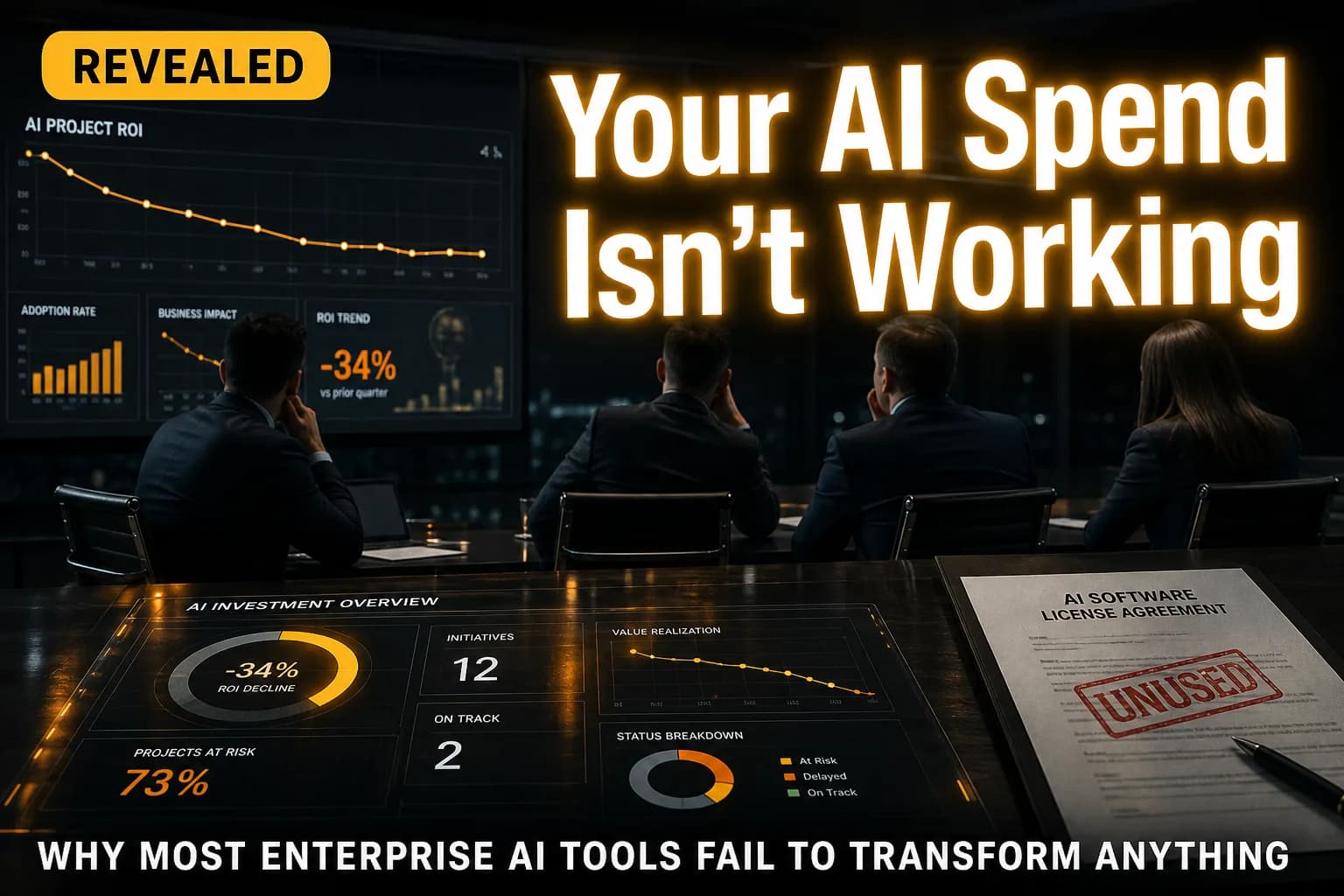
Benedict Evans opened his September 2026 essay with a number that should worry every CFO who signed an AI contract this year: enterprises are spending at record levels on AI tools, yet the share reporting measurable business transformation has barely moved. The essay, published on his personal site and picked up on Hacker News where it collected 153 upvotes in a single news cycle, argues that the industry has confused tool purchase with organizational change — and that gap is where budgets go to die. For anyone currently evaluating the best AI tools for business, Evans' piece is less a think-piece and more a warning label.
Evans, a former general partner at Andreessen Horowitz and one of the more widely-read independent analysts covering tech strategy, isn't arguing AI doesn't work. He's arguing that most companies are deploying it the way they'd deploy a new printer — bolted onto existing workflows, unsupervised, unmeasured — and then acting surprised when the transformation promised in the sales deck never shows up. The Hacker News thread reflects the same split you'd expect: engineers who've watched internal AI rollouts stall next to a smaller, vocal group insisting the tools work fine when the implementation isn't sabotaged by middle management.
What Evans Actually Argues
The core claim in the essay is structural, not technical. Evans draws a comparison to earlier waves of enterprise software — ERP systems, CRM platforms, cloud migration — where the tools themselves were rarely the bottleneck. The bottleneck was always whether an organization was willing to redesign processes, retrain staff, and kill legacy workflows that the new tool made redundant.
AI tools, Evans writes, expose this same failure mode faster and more visibly because the hype cycle compresses the timeline. A company can buy a CRM and quietly underuse it for five years without anyone noticing. Buy an AI copilot, underuse it for five months, and the board wants to know why the transformation slide from the vendor pitch hasn't materialized.
 office workers ignoring AI dashboard.
Who Gains From This Argument
Evans' framing is good news for a specific group: vendors and consultants who sell implementation, not just software licenses. Companies like Accenture, Deloitte, and a growing tier of specialized AI-integration shops benefit directly from a narrative that says "the tool isn't the hard part, the change management is" — because that reframes the expensive, billable-hours part of AI adoption as the necessary part, not the wasteful part.
It's also good news for internal AI champions — the product managers and ops leads who've been arguing for headcount and process redesign budget alongside their software requests. Evans gives them a citable, widely-shared argument for why the tool line-item on its own was never going to be enough.
The losers are less visible but easier to name in aggregate: any enterprise that bought an AI tool in 2024 or 2025 expecting the software itself to generate the productivity gain, without funding the retraining or workflow redesign around it. Evans doesn't name specific companies — the essay stays at the level of pattern, not case study — but the pattern he describes matches the public complaints from CIOs at multiple Fortune 500 firms over the past 18 months about AI pilots that never scaled past a small team.
How to Actually Evaluate the Best AI Tools for Business
Evans' essay doesn't hand readers a checklist, but the argument implies one. The evaluation question isn't "does this tool have good benchmarks" — it's "will this organization actually change how it works because of this tool." That's a much harder question to answer in a sales demo.
Three filters follow directly from his framing:
Does the tool eliminate a step, or just speed one up? Tools that let people do the old workflow faster tend to get absorbed without changing outcomes. Tools that force a workflow to be redesigned — because the old process literally can't coexist with the new capability — are the ones more likely to show up in the P&L.
Is there a named owner accountable for the outcome, not the deployment? Evans' argument about ERP and CRM history is really an argument about accountability. If the person responsible for the AI rollout is measured on "did we roll it out" rather than "did revenue-per-employee change," the tool will get bought and then quietly ignored.
Can the vendor point to a customer who changed a process, not just adopted a feature? Case studies that describe usage metrics — messages sent, queries run, seats activated — are marketing. Case studies that describe a process that no longer exists because the tool made it obsolete are evidence.
 checklist ROI evaluation framework.
The Strongest Objection to Evans' Framing
The best counterargument, and one that surfaced repeatedly in the Hacker News thread, is that Evans is applying a slow-diffusion model (ERP, cloud) to a technology moving at a genuinely different speed. Cloud migration took a decade to become table stakes. Large language model capability has meaningfully changed multiple times within a single fiscal year. Judging 2025-era AI deployments by whether they've produced ERP-style transformation yet may simply be premature — the tools this year are not the tools companies bought last year, and Evans' own essay concedes the underlying models keep improving faster than most organizations can absorb.
That's a fair point, and it deserves a direct answer rather than a dismissal. Evans' response, implicit in the essay's structure, is that the speed of the underlying model has never been the constraint — the constraint has always been organizational willingness to change, and that willingness doesn't move faster just because GPT-5-class models shipped this year instead of next. A company that hasn't redesigned a single workflow around AI by its third or fourth model upgrade cycle isn't waiting for better technology. It's demonstrating the same change-resistance that stalled CRM adoption for years at plenty of large firms, just with a shinier tool sitting unused instead of an older one.
Both things can be true at once: the technology is improving unusually fast, and most organizations are still the limiting factor. That's arguably the more useful reading of the essay than either "AI is overhyped" or "AI just needs more time."
What This Means for Budget Decisions Right Now
If you're currently building a shortlist of the best AI tools for business, Evans' essay is a case for weighting vendor selection toward implementation support over raw feature count. A tool with fewer capabilities but a vendor that ships a 90-day workflow-redesign playbook is a better bet, by this logic, than a tool with a longer feature list and a self-serve onboarding flow.
It's also a case for internal honesty about which department is actually ready to change its process, versus which department just wants a tool to point to in a board deck. Evans' essay implies — though doesn't state outright — that the failure rate cited across the industry isn't evenly distributed. Some teams get real gains. Most don't. The difference tracks organizational readiness more than tool quality.
 business leader weighing AI decision.
Steps to Take Before Your Next AI Purchase
- Map the specific workflow the tool will change, in writing, before signing — not the department, the actual sequence of steps that will be eliminated or restructured.
- Name one accountable owner whose performance review depends on the measured outcome (cost saved, cycle time reduced) rather than the deployment milestone (tool activated, team trained).
- Request a reference customer who redesigned a process, not one who reports usage volume, and ask specifically what stopped happening once the tool went live.
- Set a 90-day checkpoint with a kill criterion — a defined threshold below which the deployment is paused and reassessed rather than allowed to quietly become permanent overhead.
- Budget separately for change management as a line item distinct from the software license, matching or exceeding the license cost if the vendor's own case studies suggest that ratio.
Frequently Asked Questions
What did Benedict Evans actually say about enterprise AI?
Evans argued in his September 2026 essay that most enterprise AI deployments fail to produce measurable transformation because companies buy the tools without redesigning the workflows or accountability structures around them. He compares this to earlier enterprise software cycles like ERP and CRM, where adoption without process change produced the same stalled results.
How do I find the best AI tools for business instead of hype?
Focus less on benchmark scores and more on whether the vendor can show a customer who eliminated a process step entirely, not just accelerated one. Prioritize tools with implementation support and a defined accountability structure over tools with the longest feature list.
Why did this essay get so much attention on Hacker News?
The 153-upvote thread reflects a real tension among technical and business readers: many have personally watched internal AI pilots stall after initial enthusiasm, while others argue the technology is moving too fast for slow-diffusion comparisons to apply fairly. That unresolved disagreement is what drove sustained discussion rather than consensus.
Related Articles

How To Disable AI Mode On Google (And Stop Overpaying On Search)

Ed Zitron Called the AI Bubble Two Years Ago. Dan Luu Just Checked His Math.
EFF Tells Courts: Stop Rewriting Copyright Law Because AI Is Trendy