Decker Is the HyperCard Revival Power Users Didn't Know They Needed
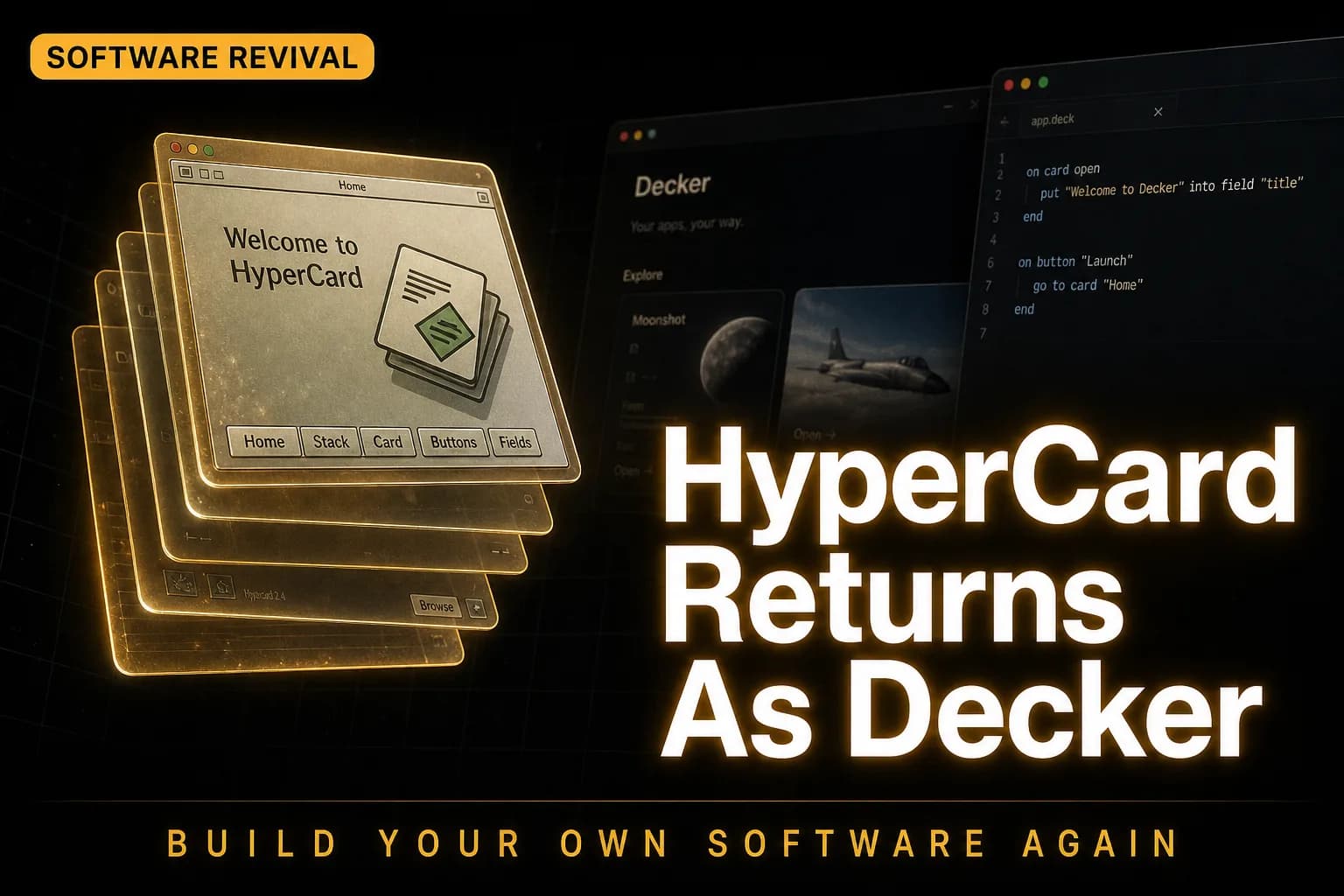
Decker HyperCard Platform Revival Is Rewriting the Rules of DIY Software
The Decker HyperCard platform landed on Hacker News with 355 upvotes and an unusual reaction: not hype, but recognition. Built by developer Jimmy Miller under the beyondloom.com banner, Decker resurrects Apple's 1987 HyperCard model — stacks of clickable "cards" containing text, buttons, and simple scripts — but runs entirely in a modern browser. No plugins, no legacy emulation, no nostalgia gimmick. It's a genuine attempt to answer a question the industry stopped asking: what if regular people could build their own software again?
That question mattered enormously in the late 1980s and early 1990s. HyperCard shipped free with every Macintosh from 1987 to 1992, and it powered everything from Myst's original prototype to corporate training tools and personal databases. Apple discontinued it in 2004. Decker treats that discontinuation not as inevitability but as a design failure the industry never corrected.
Why the HyperCard Platform Model Disappeared
HyperCard's death wasn't really about technology — it was about business models. Steve Jobs returned to Apple in 1997 with a mandate to simplify the product line, and HyperCard didn't fit the consumer-appliance vision that produced the iMac and, later, the iPhone. The web also absorbed HyperCard's use cases, but imperfectly: browsers optimized for consuming content, not authoring it.
The result was a 20-year gap where "end-user programming" mostly meant Excel macros or, if you were ambitious, learning JavaScript. Scratch filled the gap for kids. Nothing filled it for adults who wanted to build a real tool in an afternoon without touching a build pipeline. Decker's HyperCard platform lineage directly targets that abandoned middle ground.
 vintage Macintosh HyperCard interface.
What Decker Actually Does Differently
Decker isn't a HyperCard emulator — it's a from-scratch reimplementation with modern constraints baked in. Stacks are saved as portable files, cards support vector drawing tools reminiscent of MacPaint, and the scripting language (called "Decker-talk," a HyperTalk descendant) runs client-side with no server dependency. You can build, test, and share a working app entirely inside a browser tab.
Three design decisions separate it from typical no-code tools flooding the market in 2024:
- Local-first files — stacks live as files you own, not accounts locked to a SaaS vendor.
- Visible source — every card's script is inspectable and editable in place, no hidden black-box logic.
- Immediate mode — changes apply instantly; there's no separate "preview" or deploy step.
That last point echoes what Bret Victor and the broader "malleable software" research community (including projects like Glamorous Toolkit and Luminary) have argued for years: the gap between building and using software should collapse to nearly zero. Decker operationalizes that argument rather than just theorizing it.
The Hacker News Reaction Reveals Pent-Up Demand
A 355-upvote thread on a niche developer-tools link is not automatic; Hacker News' front page churns dozens of submissions daily, and most software-history projects get a polite nod and disappear. Decker's thread instead filled with people describing childhood HyperCard projects, teachers who used it for interactive lesson plans, and indie developers actively porting old stacks into Decker's format.
That pattern — adults in their 30s and 40s reconnecting with a tool from age 10 — signals something beyond nostalgia. It reflects frustration with the current software landscape's complexity tax: React toolchains, npm dependency trees, cloud billing surprises. Decker's HyperCard platform revival offers a legible alternative where the entire mental model fits in your head in one sitting.
 modern browser tab coding interface.
Where Decker Fits Against Modern No-Code Tools
Compare Decker to Bubble, Glide, or Retool, and the philosophical gap is stark. Those platforms optimize for shipping SaaS products and monetize through subscription tiers, often $30-$100+ per month for meaningful usage. Decker has no pricing page because it has no server-side business model — it's closer to a file format and runtime than a company.
This matters for the type of software Decker enables. Nobody's building a Stripe-integrated marketplace in Decker. People are building personal wikis, interactive fiction, small utilities, digital zines, and teaching tools — the exact category HyperCard dominated before the web ate it. The constraint is the feature: limited scope keeps the barrier to entry near zero.
The Longer Signal Behind Decker's Traction
Decker arrives alongside a broader 2024 pattern: renewed interest in local-first software (see the Ink & Switch research collective), skepticism of cloud lock-in, and a small but vocal movement toward "personal computing" in the literal sense — software you fully own and control. Robin Sloan, the novelist and technologist behind beyondloom.com, has written extensively about this ethos, framing tools like Decker as acts of resistance against increasingly extractive software platforms.
The HyperCard platform's original promise — that computers should be authorable, not just usable — never fully died. It went underground into hobbyist communities, retrocomputing forums, and academic HCI research. Decker's Hacker News moment suggests that underground current is now surfacing into mainstream developer attention, aided by browsers powerful enough to make it frictionless.
minimalist stack-based app builder.
What This Means If You Build Software
Decker won't replace your production stack, and it isn't trying to. But it's a useful stress test for whether your current tools have become more complex than the problems you're solving with them. If a weekend project requires a build system, a deployment pipeline, and three config files, Decker's existence is a quiet rebuke.
The bigger takeaway for Softcore Future readers: platforms like Decker are early indicators of where developer sentiment is heading — toward simplicity, ownership, and legibility, away from cloud-dependent complexity. Watching what gains traction on Hacker News right now is watching next year's "obvious in hindsight" tooling trend take shape.
Steps to Try the Decker HyperCard Platform Yourself
- Visit beyondloom.com/decker and open the in-browser runtime — no installation or account required.
- Load one of the sample stacks to see card navigation, buttons, and Decker-talk scripts in action.
- Duplicate a sample stack and modify a button's script to change behavior, learning by editing rather than reading documentation.
- Build a minimal five-card stack (a simple database, journal, or game) to test the full authoring loop.
- Export your stack as a local file and share it directly, bypassing any hosting requirement.
Frequently Asked Questions
What is the Decker HyperCard platform exactly?
Decker is a browser-based reimplementation of Apple's HyperCard, letting users build interactive "stacks" of cards with graphics, buttons, and scripts. It runs entirely client-side with no installation, account, or server dependency required.
Is Decker affiliated with Apple or the original HyperCard?
No. Decker is an independent, from-scratch project by developer Jimmy Miller, inspired by HyperCard's design but not derived from Apple's original code or trademarks. It's a spiritual successor, not an official revival.
Can Decker replace modern no-code tools like Bubble or Glide?
Not for commercial SaaS products — Decker has no backend, billing, or hosting infrastructure. It's better suited to personal tools, teaching aids, and small creative projects where simplicity matters more than scale.
Related Articles

Benedict Evans Says Most Enterprise AI Spend Is Wasted — Here's What Actually Works

How To Disable AI Mode On Google (And Stop Overpaying On Search)

Ed Zitron Called the AI Bubble Two Years Ago. Dan Luu Just Checked His Math.