Best Open Source LLM Right Now: 9 Models Compared (Plus Where Mojo Fits)
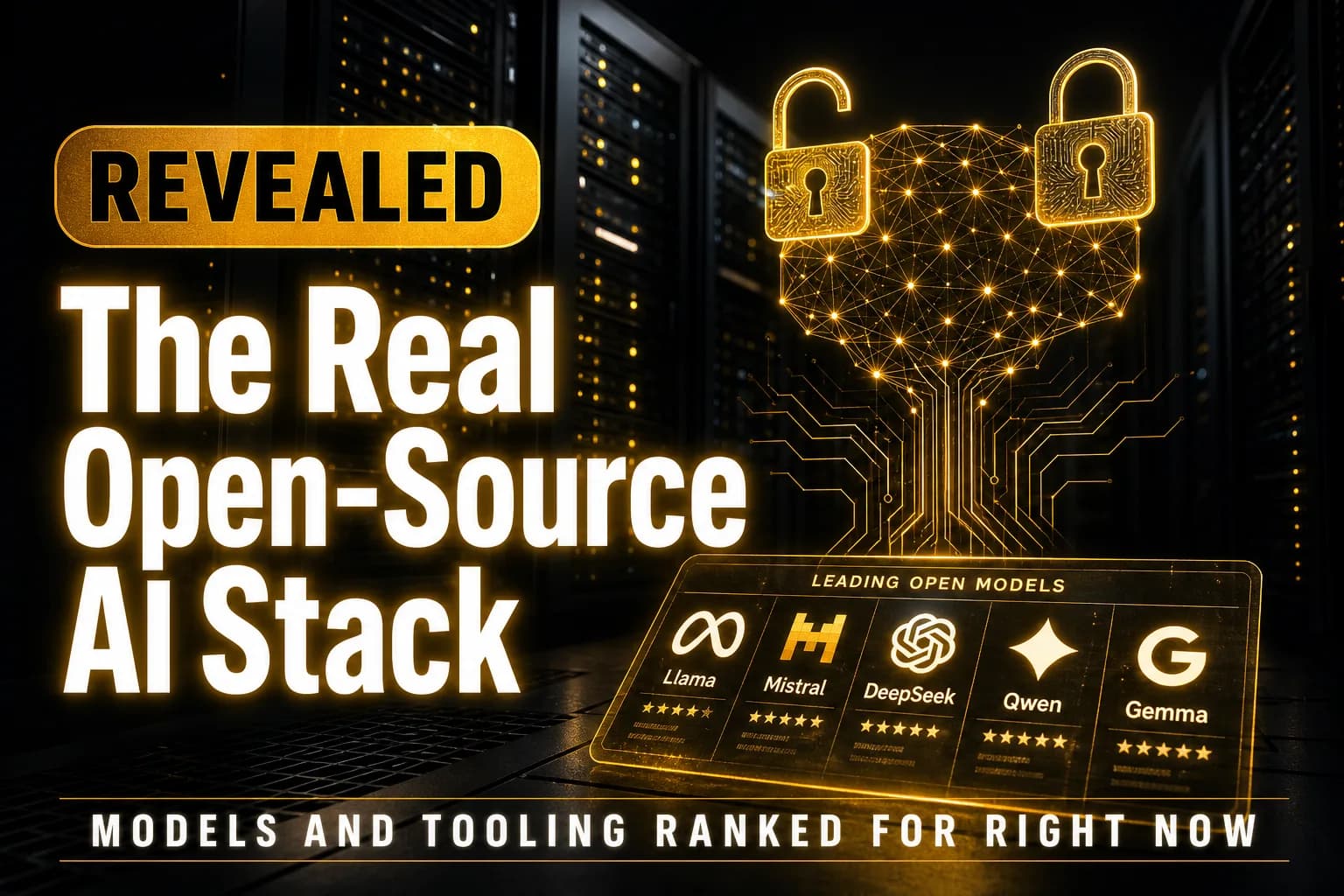
Modular open-sourced Mojo's core language and standard library on the same week DeepSeek's V3 update quietly reclaimed the top spot on several open-weight leaderboards — a reminder that "open source AI" now means two separate things: the models and the infrastructure that runs them.
If you searched for the best open source llm now, you're probably trying to answer a narrower question: which model should I actually download, fine-tune, or build a product on top of this month. That answer keeps shifting, which is why most listicles go stale within eight weeks. This guide is structured to stay useful anyway — we're ranking by use case and licensing reality, not by a single leaderboard snapshot, and we're tracking where new tooling like Mojo changes the calculus for running these models cheaply.
What "Best Open Source LLM" Actually Means in 2025
The phrase gets used loosely. Some people mean highest MMLU or GPQA score. Others mean best model you can legally use in a commercial product without a lawyer's sign-off. Those are different lists.
DeepSeek-V3 and its reasoning-focused sibling R1 currently top most raw capability benchmarks among openly licensed models, trading blows with proprietary GPT-4-class systems on math and code tasks at a fraction of the training cost — DeepSeek claimed roughly $5.6 million for the V3 base training run, though independent estimates that exclude prior research and infrastructure costs put the real number higher. Meta's Llama 3.3 70B and the newer Llama 4 Scout/Maverick pair remain the default choice for enterprises because of Meta's legal backing and the sheer size of the surrounding tooling ecosystem. Alibaba's Qwen 2.5 and Qwen 3 series lead on multilingual tasks and are increasingly the default pick for teams outside the US and Europe.
Mistral's models — Mistral Small 3 and the Mixtral mixture-of-experts line — remain the pragmatic middle ground: genuinely Apache 2.0 licensed, no usage restrictions, and small enough to run on a single consumer GPU.
The Current Top Open-Source LLMs Ranked by Use Case
Best raw reasoning capability: DeepSeek-R1 (671B parameters, MoE architecture, MIT license). It matches OpenAI's o1 on several math and coding benchmarks and is fully open-weight, which is unusual at this capability tier.
Best for commercial products without licensing headaches: Mistral Small 3 and Mixtral 8x22B. True Apache 2.0 licensing means no revenue-threshold clauses, unlike Llama's community license, which requires a separate agreement from Meta once your product hits 700 million monthly active users.
Best for local, consumer-hardware inference: Qwen 2.5 7B and Llama 3.2 3B. Both run comfortably on a 16GB GPU with quantization and are the default choices in tools like Ollama and LM Studio.
Best for multilingual and non-English use cases: Qwen 3, which was trained on a notably higher proportion of non-English tokens than Llama or Mistral and consistently outperforms them on multilingual benchmarks like Belebele.
Best for long-context document work: Llama 4 Scout, with a context window advertised up to 10 million tokens, though practical, coherent recall drops well before that ceiling in most independent tests.
 server room with glowing GPU racks.
Where Mojo Fits Into the Open-Source AI Stack
Here's the part most "best LLM" lists skip entirely: the model file is only half the equation. The other half is the software that turns those weights into tokens per second, and that layer has quietly become just as competitive as the model race itself.
Mojo, built by Modular and led by Chris Lattner (the creator of Swift and LLVM), open-sourced its core language and standard library in mid-2025 under the Apache 2.0 license, following years of the compiler being closed while the syntax layer was public. The pitch is specific: Python-compatible syntax with systems-level performance, aimed squarely at the gap between Python's ease of use and CUDA/C++'s speed for AI workloads. Modular has published benchmarks showing Mojo-based kernels outperforming hand-tuned CUDA implementations on certain matrix operations without vendor lock-in to Nvidia hardware.
That matters for the open-source LLM conversation because inference cost, not model quality, is now the bottleneck for most teams actually deploying these systems. A model like Qwen 2.5 or Llama 3.3 is free to download; running it efficiently at scale is not. Tools like Mojo, alongside vLLM, llama.cpp, and Nvidia's TensorRT-LLM, form the unglamorous plumbing layer that determines whether "open source LLM" translates into an affordable product or a GPU bill nobody can justify.
Mojo isn't a model, and it doesn't compete with DeepSeek or Llama directly. It competes with CUDA, Triton, and the layer of infrastructure code that decides how fast an open model actually runs on real hardware — including non-Nvidia chips, which is where Modular is making its long-term bet.
Licensing Terms That Actually Change What You Can Build
Open source AI licensing is not standardized, and the differences carry real legal weight.
Meta's Llama models use the Llama Community License, not a standard OSI-approved open-source license. It permits commercial use but requires a separate license from Meta once monthly active users exceed 700 million — a threshold that excludes almost everyone, but one worth knowing about if you're building at serious scale. DeepSeek's models ship under the MIT license, among the most permissive options available, with no usage-tier restrictions. Mistral's Apache 2.0 license and Mojo's newly-adopted Apache 2.0 license both fall into the same permissive category: modify, redistribute, and commercialize without asking permission.
Qwen's licensing varies by model size — smaller variants use Apache 2.0, while some larger Qwen models carry usage restrictions similar to Llama's. Always check the specific model card rather than assuming a family-wide license applies uniformly.
 open padlock icon over code.
How to Actually Choose Between These Models
Match the model to the constraint that's actually binding your project, not the benchmark that looks most impressive in a tweet.
If your bottleneck is GPU memory, start with a quantized Qwen 2.5 7B or Llama 3.2 3B rather than reaching for a 70B-parameter model you can't run. If your bottleneck is legal exposure, default to Apache 2.0 or MIT-licensed models — Mistral or DeepSeek — over Llama's community license. If your bottleneck is raw reasoning quality and you have the infrastructure budget, DeepSeek-R1 currently sets the bar among open-weight models. If your bottleneck is inference cost at scale, the model choice matters less than the runtime — this is where evaluating Mojo, vLLM, or TensorRT-LLM against your specific hardware pays off more than switching model weights again.
A pattern worth remembering: the "best" model six months ago is rarely the best model now, but the licensing category it falls into almost never changes. That's the more durable decision.
Steps to Pick the Right Open-Source LLM Today
- Define your binding constraint first — hardware, license, latency, or raw capability — before comparing benchmark scores.
- Check the exact license text on the model card, not just the family name, since permissions vary by model size and version.
- Benchmark on your own prompts and hardware using a tool like llama.cpp or vLLM rather than trusting published leaderboard numbers alone.
- Evaluate the inference runtime separately from the model — Mojo, TensorRT-LLM, and vLLM can change your cost per token by a large margin without touching the model weights.
- Revisit this decision quarterly; open-weight releases from DeepSeek, Alibaba, Meta, and Mistral have shipped major updates roughly every 8-12 weeks through 2024 and 2025.
Frequently Asked Questions
What is the best open source LLM right now for a beginner?
For most beginners running local hardware, Llama 3.2 3B or Qwen 2.5 7B offer the best balance of quality and resource requirements, and both have first-class support in Ollama and LM Studio. Start there before attempting to run anything above 30B parameters locally.
Is DeepSeek actually open source or just open-weight?
DeepSeek releases model weights under the MIT license along with technical papers, but the full training data and pipeline are not published, which makes it "open-weight" rather than fully open source in the strictest sense. Most of the industry, including Meta's Llama, uses the same looser definition.
Does Mojo replace Python for AI development?
No — Mojo is designed to be a superset of Python's syntax, not a replacement, letting developers write performance-critical code in a Python-like language without switching to C++ or CUDA. Most teams will keep using Python for glue code and reach for Mojo specifically for compute-heavy kernels.
Related Articles

Best AI Meeting Note Taker App: A Security-First Buyer's Guide After the tl;dv Leak

Benedict Evans Says Most Enterprise AI Spend Is Wasted — Here's What Actually Works

How To Disable AI Mode On Google (And Stop Overpaying On Search)