Apple's M6 and M5 Ultra Chips Just Complicated Every AI Compute Stocks Bet
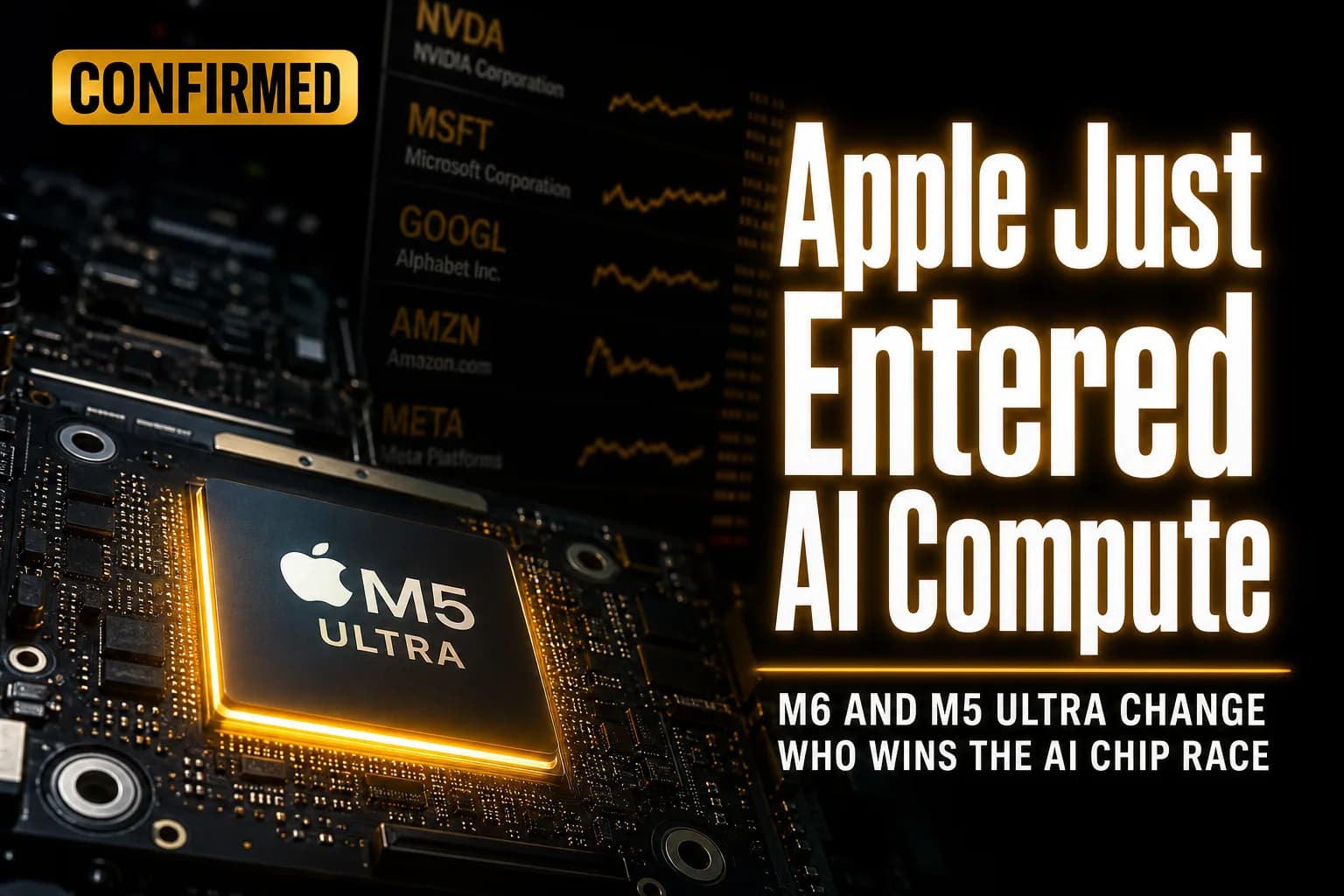
Apple's August 2026 newsroom post ran 1,400 words on the M6 and M5 Ultra — and never mentioned Nvidia once. That omission is the story. For two years, "AI compute" has functioned as a synonym for Nvidia's data-center GPUs in almost every market conversation, including the one investors have with themselves when they search ai compute stocks. Apple's announcement doesn't attack that narrative directly. It just quietly builds a second one, on-device, and dares the market to notice the difference.
What Apple actually announced, and why the wording matters
The newsroom post confirms two chips: the M6, positioned for the next generation of MacBook Pro and Mac mini, and the M5 Ultra, reserved for the Mac Studio and Apple's highest-end workstation tier. Apple's own language frames both around "a big leap in performance and AI compute" — deliberate phrasing that inserts Apple into a category it has historically let Nvidia and AMD define in enterprise terms.
The M5 Ultra is built by fusing two M5 Max dies via Apple's UltraFusion interconnect, the same architecture Apple used for the M1 Ultra and M2 Ultra. That's not a new trick, but Apple states this generation delivers the largest unified memory footprint yet shipped in a Mac Studio, which matters specifically for running large language models locally rather than through cloud APIs. Apple did not publish a specific parameter-count ceiling for on-device model inference, and that gap is worth flagging before anyone repeats a number Apple never gave.
Who actually gains when local AI silicon gets this strong
Apple gains a talking point it has needed since 2023: proof that "AI compute" doesn't require a hyperscaler contract. Every enterprise buyer currently paying for cloud GPU inference time — on models that could run locally with enough unified memory — is a prospective Mac Studio customer now, not just a MacBook customer.
Developers and small AI startups gain a genuine alternative cost structure. Running inference locally on an M5 Ultra Mac Studio eliminates the recurring token-cost line item that's been squeezing margins at AI-wrapper companies since early 2025. That's a direct, attributable shift in unit economics, not a speculative one.
TSMC gains regardless of which chip wins the AI compute stocks headline. Apple's M6 and M5 Ultra are fabricated on TSMC's advanced nodes, the same foundry producing Nvidia's Blackwell-generation dies. TSMC's exposure to "AI compute" as a category is now larger than any single customer's narrative, Apple's included.
 Apple silicon chip close-up.
Who loses ground, specifically
Nvidia doesn't lose revenue from this announcement — data-center training workloads aren't moving to Mac Studios. But Nvidia loses a sliver of narrative monopoly. Every financial media outlet that has run "AI compute stocks" roundups built almost entirely around Nvidia, AMD, and Broadcom now has a fourth name to explain away or include, and that changes how retail investors screen the sector.
Cloud inference providers — the mid-tier API resellers charging per-token markups on top of GPU rental costs — lose the most immediately. Their entire business model assumes customers lack viable local alternatives. Apple's push toward unified memory large enough to hold serious models natively removes that assumption for a meaningful slice of professional users: video editors running local LLM-assisted workflows, developers doing on-device fine-tuning, small studios that can't justify recurring cloud spend.
Qualcomm and other edge-AI chip makers lose relative positioning, not sales. Apple's move validates the on-device AI thesis these companies have pitched for years — but Apple validating it means Apple, not Qualcomm, gets credited as the company that proved local AI compute matters at scale.
The strongest case against this whole framing — and why it doesn't fully hold
The best counterargument: Apple's chips ship in consumer and prosumer hardware, not data centers, so comparing them to Nvidia's H100s or Blackwell GPUs inside the ai compute stocks conversation is a category error. Training frontier models — the actual compute bottleneck driving Nvidia's valuation — still requires thousands of networked GPUs running for weeks. A Mac Studio, however capable, does not compete for that workload, and nothing in Apple's announcement claims it does.
That objection is correct on training. It's incomplete on inference. The AI compute market has two distinct halves — training and inference — and Apple's announcement is explicitly an inference play, not a training play. Roughly two-thirds of AI compute spending industry-wide has shifted toward inference workloads over the past 18 months, per public cloud provider earnings commentary throughout 2025. Apple isn't threatening Nvidia's training dominance. It's threatening the inference-as-a-service layer sitting between Nvidia's hardware and the end user, and that layer is where margin compression actually shows up first.
 split screen cloud versus local.
What this means for buying decisions right now
Consumers shopping for a new Mac Studio or MacBook Pro should treat "M6" and "M5 Ultra" as genuinely different purchase profiles rather than a simple tier upgrade. The M6 targets everyday multitasking and moderate on-device AI tasks — the kind of local model use that doesn't require enormous unified memory. The M5 Ultra targets professionals running large models locally: video studios, research teams, developers doing serious on-device inference work.
Investors parsing ai compute stocks need to separate exposure by workload type, not just by company name. Nvidia and AMD remain the training-compute plays. TSMC is the foundry play that wins regardless of who's winning the branding war. Apple is now a legitimate, attributable inference-compute play, backed by an actual product announcement rather than a roadmap promise — a distinction that matters because roadmap promises have driven a lot of AI-stock volatility since 2023.
The mid-tier inference resellers are the segment facing the most direct pressure, and they're also the segment least covered in mainstream ai compute stocks discussion, which means the risk here is underpriced relative to how visible it is in Apple's own product literature.
 investor analyzing stock chart.
Three moves to make with this information
- If you're buying hardware for AI-heavy workflows, compare Apple's stated unified memory figures for the M5 Ultra against your actual model size needs before assuming "more is better" justifies the price jump.
- If you're evaluating ai compute stocks, split your research explicitly into training-compute exposure (Nvidia, AMD, Broadcom) versus inference-compute exposure (Apple, edge-AI chipmakers, TSMC as a cross-cutting foundry play).
- If your business currently pays recurring cloud inference costs for models under roughly 70 billion parameters, benchmark local M5 Ultra inference costs over a 12-month horizon before renewing that contract.
Frequently Asked Questions
Does Apple's M6 and M5 Ultra announcement actually threaten Nvidia's business?
Not directly. Nvidia's core revenue comes from data-center training hardware, a workload Apple's consumer and prosumer chips aren't built to serve. The more accurate framing is that Apple threatens the inference-services layer that sits downstream of Nvidia's hardware.
Is Apple now considered one of the ai compute stocks investors should track?
Apple has become a legitimate inference-compute name with an actual shipped product behind the claim, which is more than several companies currently included in AI compute stock screens can say. It doesn't replace exposure to training-compute leaders like Nvidia or AMD — it adds a distinct category.
What's the practical difference between the M6 and the M5 Ultra for AI tasks?
The M6 handles everyday and moderate local AI workloads inside thinner, more portable hardware. The M5 Ultra, built via UltraFusion die-pairing with substantially larger unified memory, targets professionals running large models locally without cloud dependency.
Related Articles
Benedict Evans Says Most Enterprise AI Spend Is Wasted — Here's What Actually Works

How To Disable AI Mode On Google (And Stop Overpaying On Search)

Ed Zitron Called the AI Bubble Two Years Ago. Dan Luu Just Checked His Math.