AI Model Comparison: We Ran One Prompt Through 11 Models So You Don't Have To
Why AI Model Comparison Is Suddenly Everyone's Problem
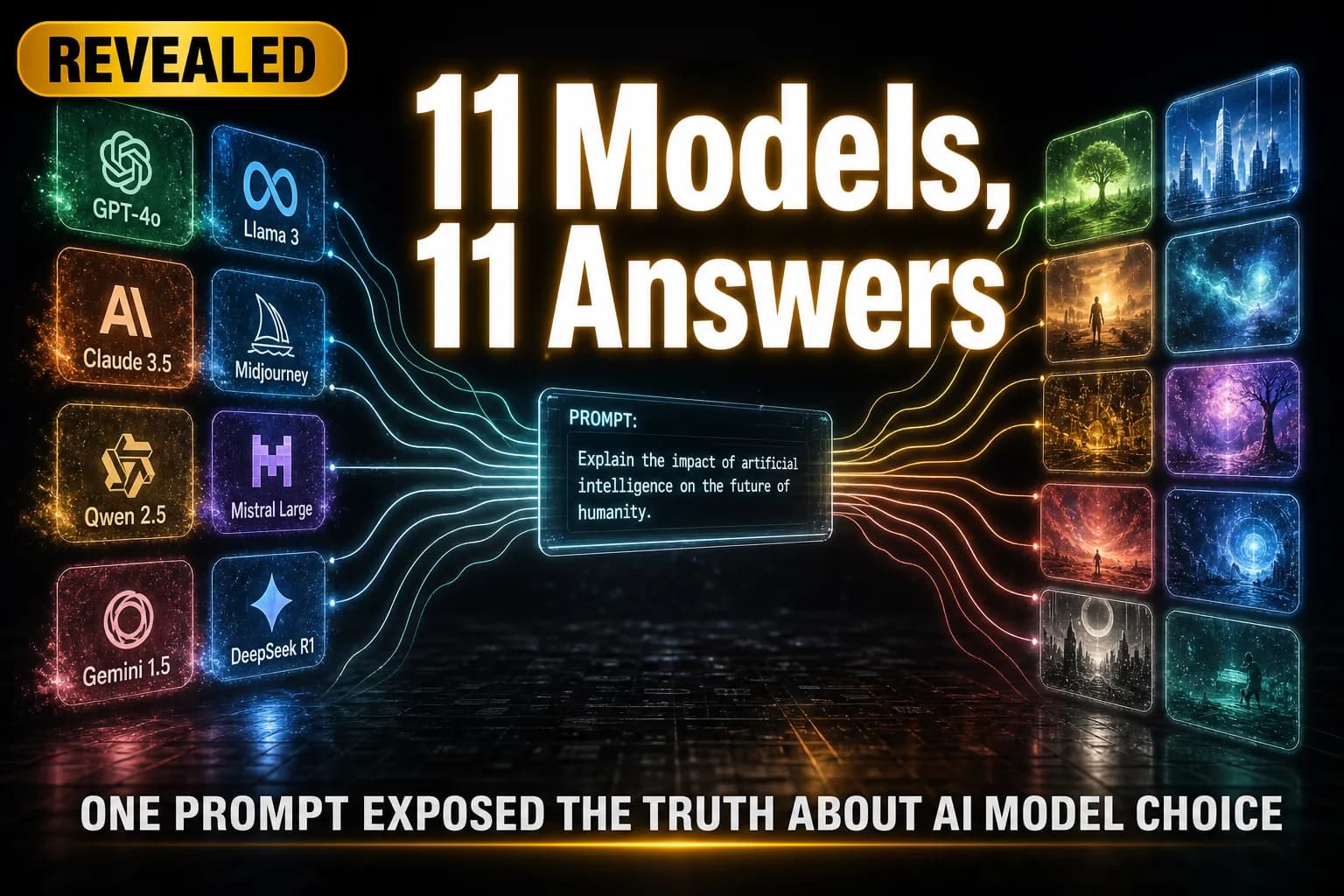
An ai model comparison experiment recently made the rounds on Hacker News, gathering over 210 upvotes for a deceptively simple idea: take one identical prompt, run it through 11 different AI models, and publish the raw outputs side by side. Netlify's engineering team did exactly that, and the results weren't subtle — some models nailed the task cleanly, others hallucinated structure that didn't exist, and a few produced output so different in tone and accuracy that it was hard to believe they'd received the same instructions. The experiment resonated because it confirmed something practitioners already suspected but rarely see proven so plainly: model choice is not a rounding error, it's a decision with real downstream cost.
This matters beyond one viral post. New models ship monthly, benchmark leaderboards get gamed, and marketing copy from every AI lab claims "state-of-the-art" performance. What's missing is a durable, repeatable way to answer the actual question people type into Google: which AI model should I use for this specific task. That's what this guide gives you — not a snapshot of who's winning this week, but a framework you can rerun yourself six months from now when the names on the leaderboard have already changed.
The Methodology That Actually Matters
The core insight from the Netlify experiment wasn't which model "won" — it was the method. A single, identical, non-trivial prompt was sent to every model with no follow-up clarification, mimicking how real users actually work. No prompt engineering gymnastics, no retries, no cherry-picking the best of five attempts. That constraint is what makes a comparison trustworthy instead of a sponsored puff piece.
Apply the same discipline when you evaluate models yourself:
- Use one prompt, unmodified, across every model. Changing wording between tests invalidates the comparison instantly.
- Test the actual task you care about, not a generic "write me a poem" prompt. Coding tasks need code-specific prompts; writing tasks need tone-specific ones.
- Score on task-relevant criteria — for code: does it run, is it correct, is it idiomatic; for writing: accuracy, structure, voice; for images: prompt adherence, artifacting, composition.
- Run it more than once. Non-determinism means a single generation can be an outlier — Netlify noted meaningful variance even from the same model on repeated runs.
This is the part most "AI model comparison" articles skip. They publish a leaderboard snapshot and call it done. A repeatable methodology, not a static ranking, is what actually survives the next model release.
 split screen multiple ai outputs.
Coding: Where the Gaps Are Widest
Code generation is the single most consequential category in any ai model comparison, because errors are objectively verifiable — the code either compiles and passes tests, or it doesn't. In the Netlify test and in parallel community benchmarks like LiveCodeBench and SWE-bench Verified, models cluster into rough tiers rather than a smooth gradient.
Frontier reasoning-tuned models (the current top tier includes Anthropic's Claude Opus/Sonnet line and OpenAI's o-series/GPT-5-class models) consistently handle multi-file context, edge cases, and instruction-following on ambiguous specs better than general-purpose chat models. Mid-tier models produce code that looks plausible but silently drops error handling or fabricates library methods that don't exist — a failure mode far more dangerous than an outright refusal, because it passes casual review.
Practical takeaway: for production coding tasks, prioritize models benchmarked specifically on SWE-bench or real repository tasks, not general chat leaderboards like LMArena, which reward conversational polish more than correctness.
Writing: Where "Better" Gets Subjective
Writing tasks are where an ai model comparison gets messy fast, because there's no compiler to tell you who's right. What the Netlify prompt exposed clearly, though, is consistency of instruction-following — some models respected formatting constraints (word count, tone, structure) precisely, while others drifted after a paragraph or two.
Three practical patterns show up repeatedly across independent tests:
- Models trained with heavier RLHF-for-helpfulness (like GPT-4o/GPT-5-class and Gemini 2.5) tend toward safe, competent, slightly generic prose unless prompted hard against it.
- Claude models generally hold structure and long-context coherence better across 2,000+ word outputs.
- Open-weight models (Llama 4, Mistral Large, Qwen 2.5/3) have closed the raw quality gap significantly but still lag on nuanced instruction-following without careful system prompting.
If your task is technical writing, documentation, or anything requiring strict adherence to a format, weight your evaluation toward instruction-following over "does this sound impressive." If it's creative or brand voice writing, run a blind read-through — you'll spot the generic model instantly once you're not told which is which.
Image Generation: The Category With the Most Visible Variance
Image generation is arguably where an ai model comparison produces the most dramatic, immediately visible differences, because output quality doesn't require expertise to judge — anyone can see when hands are malformed or text is garbled. Current leaders like Midjourney v6/v7, OpenAI's GPT Image models, Google's Imagen 3, and Black Forest Labs' FLUX each have distinct, identifiable "signatures."
Midjourney still leads on aesthetic composition and stylization out of the box with minimal prompting effort. FLUX and Imagen 3 tend to win on photorealism and prompt adherence for literal, complex scenes (correct object counts, accurate text rendering). GPT Image models integrate reasoning about the prompt itself, making them stronger for compositional or instructional image requests ("show a diagram of X") than pure aesthetic generation.
 ai generated artwork comparison grid.
The practical lesson: don't pick one image model and stick with it forever. Match the model to the job — stylized marketing art, photoreal product shots, and diagram-style illustrations each favor a different tool.
Building Your Own Comparison Framework
Rather than trusting any single ranking (including this one, since model rankings shift monthly), build a lightweight internal test you can rerun in minutes:
- Keep a fixed set of 3-5 representative prompts for each task category you care about (one coding, one long-form writing, one image prompt).
- Run them through candidate models whenever a new release drops — GPT-5, Claude Opus 4.x, Gemini 2.5 Pro, and Llama 4 are the current baseline tier worth testing against.
- Track results in a simple spreadsheet: model, date, pass/fail, notable failure mode.
- Weight cost and latency alongside quality — a model that's 95% as good at one-tenth the price is often the correct production choice, not the "best" model on a leaderboard.
 developer reviewing benchmark spreadsheet.
This is precisely why the Netlify experiment struck a nerve on Hacker News: it wasn't selling a winner, it was demonstrating a method anyone can replicate with their own workload instead of trusting vendor marketing.
Take Action: Choosing the Right Model Today
- Define your task category first — coding, writing, or image generation — since "best AI model" is meaningless without a task attached.
- Write one fixed, realistic prompt for that task and run it, unmodified, across 3-4 current leading models.
- Score against objective criteria relevant to the task (compiles/runs for code, instruction adherence for writing, prompt fidelity for images) rather than gut feel alone.
- Rerun your test set every time a major model ships — the leaderboard changes fast enough that a six-month-old ranking is unreliable.
- Factor in cost per output, not just raw quality, since many teams overpay for marginal gains they don't actually need.
Frequently Asked Questions
Which AI model is best overall for an ai model comparison in 2025?
There is no single best model across all tasks — current data shows Claude and GPT-5-class models leading on coding and long-form writing, while Midjourney and FLUX lead on image generation. The right choice depends entirely on which task category you're optimizing for.
How often should I redo my AI model comparison?
Rerun your fixed prompt set every time a major lab ships a new flagship model, typically every 2-3 months given the current release cadence. Leaderboards from six months ago are frequently outdated due to rapid model iteration.
Is a public benchmark leaderboard enough, or should I test myself?
Public leaderboards like LMArena or SWE-bench are useful starting signals but don't reflect your specific prompts, data, or formatting needs. Running your own small, fixed test set — like the Netlify experiment did — gives a far more reliable answer for your actual use case.
Related Articles
Benedict Evans Says Most Enterprise AI Spend Is Wasted — Here's What Actually Works

How To Disable AI Mode On Google (And Stop Overpaying On Search)
Ed Zitron Called the AI Bubble Two Years Ago. Dan Luu Just Checked His Math.