An AI Generated Fix Suggested by GitHub Copilot Opened the Door to Snowflake's Jira
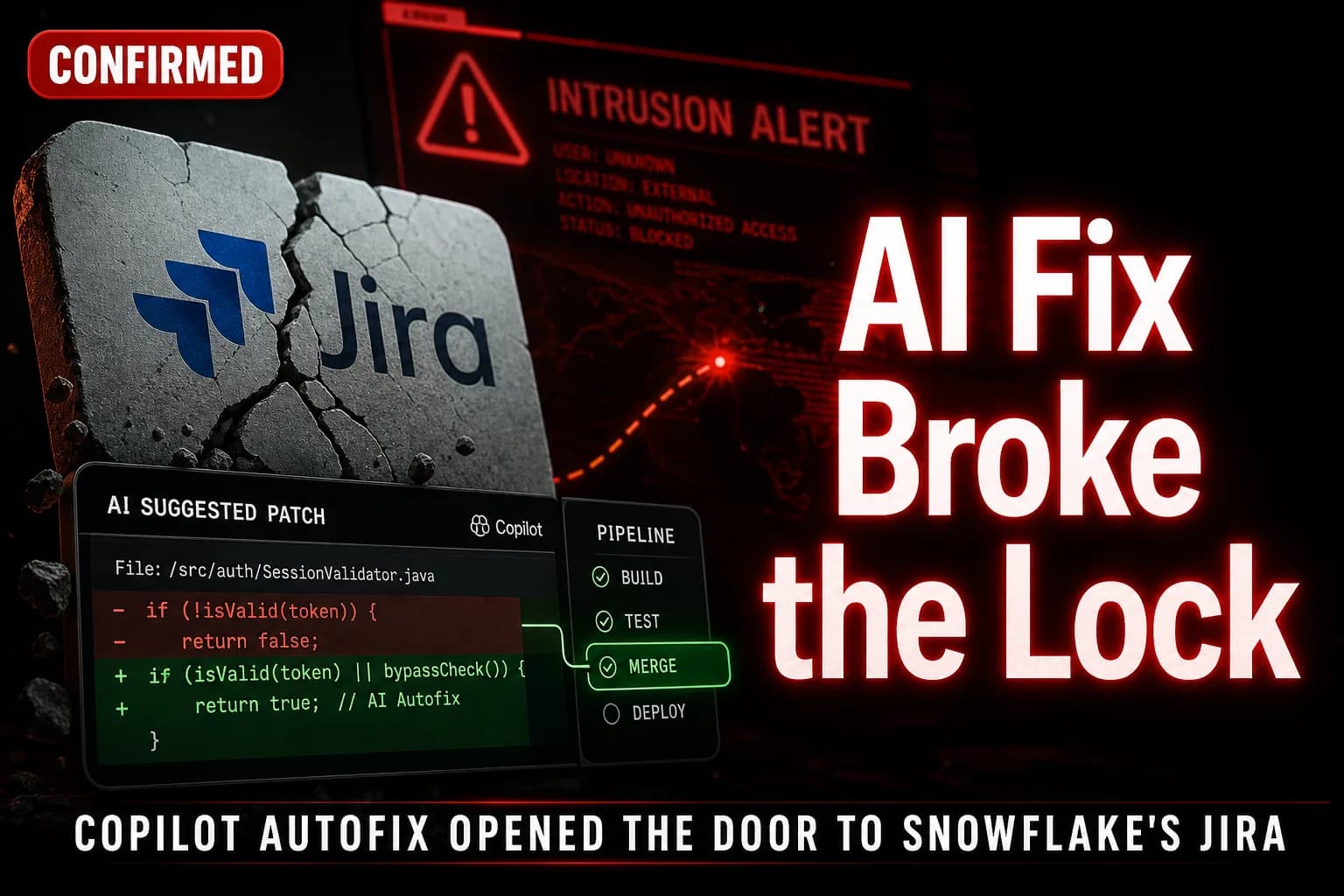
Wiz researchers found that a single AI generated suggestion from GitHub Copilot's Autofix feature introduced the exact flaw attackers used to reach Snowflake's internal Jira instance. The finding, published on Wiz's blog and amplified to 406 upvotes on Hacker News, is the first well-documented case where an AI code-review tool didn't just miss a vulnerability — it authored one, in a fix meant to close a different bug entirely.
That distinction matters more than it sounds. Security teams have spent two years debating whether AI-assisted coding makes software safer or riskier in aggregate. This report doesn't leave room for the abstract version of that debate. It names a product, describes an attack chain, and documents a real system that a real company had to remediate.
What Actually Happened Inside Snowflake's Pipeline
According to Wiz's account, the chain started with a legitimate, mundane task: a developer working in a CI/CD pipeline connected to Snowflake's Jira environment encountered a flagged issue, and GitHub Copilot's Autofix feature proposed a remediation. The suggestion was accepted. It resolved the surface-level problem it was designed to address, but it did so by weakening an access control boundary elsewhere in the same code path.
Wiz's red team — operating under what they call the "Red Agent" methodology — found that the AI generated patch created a gap between how the pipeline authenticated internal service calls and how it validated the origin of those calls. An attacker who understood this gap could route a request through the CI/CD system and reach Jira with more trust than the request should have carried. Wiz states plainly that this path was exploitable and that it led to unauthorized access to Snowflake's Jira instance.
The important nuance: this wasn't a case of Copilot hallucinating broken syntax or an obviously wrong function call. The suggestion compiled, passed existing tests, and looked like a reasonable fix to a human reviewer under normal review conditions. That's what makes it a security story instead of a QA story.
 code diff with hidden vulnerability.
Why an AI Generated Fix Is Harder to Catch Than a Human Mistake
Human-introduced vulnerabilities tend to cluster around known failure patterns — a missing sanitization step, a copy-pasted auth check that doesn't match its new context. Reviewers are trained to scan for those patterns because they've seen them before, often from the same handful of engineers or the same legacy modules.
An AI generated suggestion doesn't carry that history. It's synthesized fresh, styled to look idiomatic, and optimized to resolve the flagged issue with minimal code churn — which is exactly why it passes review faster. Wiz's report emphasizes that the Autofix suggestion was narrowly correct for the linter or scanner finding it was responding to, while being blind to the broader security context of the surrounding pipeline logic.
This is the mechanism, not a philosophical claim about AI being "untrustworthy." Autofix tools are typically scoped to resolve a specific flagged finding — a SAST alert, a dependency warning, a linting failure. They are not designed to reason about second-order effects across a service boundary, and Snowflake's incident is what happens when that scope mismatch meets a live production pipeline.
Who Gains and Who Loses From This Story
Wiz gains. The company's Red Agent research arm gets a marquee, named-vendor finding that will anchor sales conversations about AI-era attack surface monitoring for the next year. This is the kind of disclosure that becomes a conference talk and a product roadmap justification simultaneously.
GitHub and Microsoft take a reputational hit, though a narrow one. The report doesn't allege Copilot is broadly unsafe — it alleges one feature, in one configuration, produced one exploitable patch. But "Copilot Autofix" as a specific named feature is now permanently associated with a documented breach path in search results and security conference decks, regardless of how the broader product performs elsewhere.
Snowflake absorbs the direct cost. An internal tool, Jira, was compromised — not customer-facing infrastructure, based on what Wiz has published. That's a meaningfully smaller blast radius than a data-plane breach, but it still means incident response hours, a security review of every AI-suggested merge in the affected pipeline, and a disclosure conversation Snowflake didn't choose to have.
Security teams evaluating AI code review tools lose the easy answer. Before this, the pitch for AI autofix was straightforward: it catches more than a tired human reviewer and does it faster. Now every team running Copilot Autofix, Amazon CodeGuru, or similar tools in CI/CD has to explain to their CISO why this couldn't happen to them — and "it probably could" is the honest answer until proven otherwise.
 security dashboard flagging pipeline alert.
The Strongest Case Against This Framing — and Where It Breaks Down
The most credible pushback: humans introduce exploitable vulnerabilities in code review all the time, and nobody writes "Human Generated Fix Compromises Snowflake" as the headline. Studies on manual code review consistently show reviewers miss subtle authorization and boundary-condition bugs at rates comparable to, or worse than, automated tools. By that logic, singling out the AI origin of this bug is a bias, not an insight — the real story is "CI/CD pipeline lacked defense in depth," full stop.
That argument holds up right until you account for scale and trust calibration. A human engineer who introduces a bad fix does so once, reviewed by peers who know that engineer's track record and can ask why the change was made. An AI generated suggestion gets accepted across thousands of repositories with the implicit assumption that the tool is checking things a human reviewer wouldn't — which is precisely the selling point vendors use to justify these tools. The failure mode isn't that AI writes worse code than humans on average. It's that teams adjust their review rigor downward specifically because an AI tool is in the loop, and that calibration gap is what Wiz's report actually exposes.
The Snowflake incident doesn't prove Copilot Autofix is more dangerous than human review in the aggregate. It proves that treating AI-suggested fixes as lower-scrutiny than human-authored ones — which is how most teams currently operate — creates a specific, exploitable blind spot.
What This Means for Teams Running Copilot Autofix Today
Wiz's disclosure lands at a moment when Autofix-style features are shipping as default-on in more CI/CD integrations, not fewer. GitHub has continued expanding Copilot's automated remediation scope through 2024 and into 2025, and competing tools from GitLab and Snyk offer comparable auto-remediation for flagged vulnerabilities.
The practical question for any engineering org isn't whether to ban AI generated fixes — that ship has sailed for most teams — it's whether the fix gets the same security-context review a human-authored patch touching auth or access control would get. Wiz's report is implicitly an argument for treating AI generated diffs in security-sensitive code paths as higher scrutiny, not lower, precisely because they lack the tacit institutional context a human author would carry.
Steps to Reduce This Risk in Your Own Pipeline
- Flag AI generated commits touching auth, IAM, or service-to-service trust boundaries for mandatory senior review, separate from your standard PR process.
- Run a second, independent security scanner against Autofix suggestions before merge — don't let the same tool class that proposed the fix be the only one that validates it.
- Audit your CI/CD pipeline's trust boundaries quarterly, specifically checking whether internal tools like Jira, Confluence, or ticketing integrations inherit broader authentication scope than they need.
- Log and diff every accepted Autofix suggestion against the original flagged issue to confirm the fix scope matches the vulnerability scope — no silent expansion of what the patch touches.
- Treat Copilot Autofix and similar tools as a first-pass suggestion engine, not a remediation authority, especially in any pipeline with access to internal systems beyond the immediate codebase.
 engineer reviewing pipeline security audit.
Frequently Asked Questions
What is GitHub Copilot Autofix and how did it cause this issue?
Copilot Autofix is a feature that automatically suggests code changes to resolve flagged security findings from static analysis tools. In Snowflake's case, Wiz found that an accepted Autofix suggestion resolved its target issue while weakening an authentication boundary elsewhere in the same pipeline, which attackers later used to reach Jira.
Did this incident expose Snowflake customer data?
Based on what Wiz has published, the compromised system was Snowflake's internal Jira instance, not customer-facing data infrastructure. The report doesn't establish that customer data was accessed through this specific path.
Should companies stop using AI code review and autofix tools after this?
Wiz's report doesn't argue for abandoning these tools, and most security researchers agree that's impractical given adoption levels. The more defensible response is applying higher scrutiny to AI generated fixes in security-sensitive code paths rather than treating them as pre-validated.
Related Articles
Benedict Evans Says Most Enterprise AI Spend Is Wasted — Here's What Actually Works

How To Disable AI Mode On Google (And Stop Overpaying On Search)

Ed Zitron Called the AI Bubble Two Years Ago. Dan Luu Just Checked His Math.