Tomodachi Life: Living the Dream Version 1.0.2 — Full Patch Notes, Bug Fixes & What They Mean for Nintendo's Biggest Social Sim of 2026
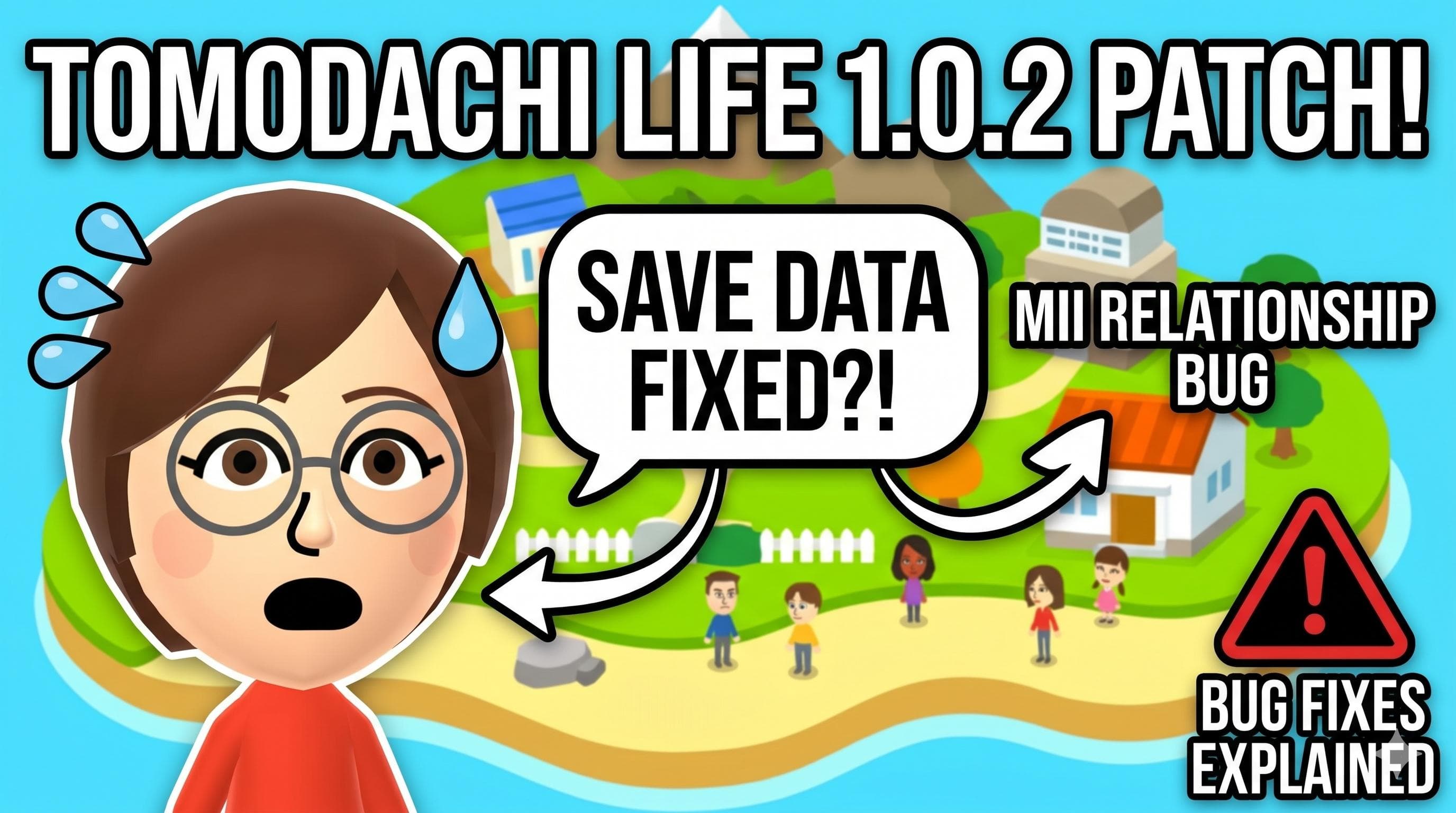
Tomodachi Life: Living the Dream Version 1.0.2 — Full Patch Notes, Bug Fixes & What They Mean for Nintendo's Biggest Social Sim of 2026
 ## The Patch That Over 50 Million Searches Demanded
On May 14, 2026, Nintendo quietly released Version 1.0.2 of Tomodachi Life: Living the Dream across all Nintendo Switch and Switch 2 consoles. What followed was anything but quiet. Within 48 hours, searches for "Tomodachi Life update patch notes" had exploded to over 50 million queries in the United States alone — a 200% surge that pushed the term to the top of Google Trends' technology category.
The numbers are staggering, but the psychology behind them is even more telling. Living the Dream is not simply a game — it has become a cultural moment. Players have been building islands, engineering Mii-celebrity mashups, and sharing viral clips of their chaotic social simulations since the game's worldwide launch on April 16, 2026. When save data started corrupting and island progression started locking up, tens of millions of emotionally invested players hit search engines in a frenzy.
This patch matters. Here is everything you need to know.
Full Version 1.0.2 Patch Notes (Official)
Nintendo's official support page lists the following fixes for the May 14, 2026 update:
🔴 Critical: Progress-Blocking Bugs Fixed
- Island progression lock: Fixed an issue where, after a player builds up their island, the game would sometimes become unable to progress.
- Palette House exterior bug: Fixed an issue where changing the exterior of a house created at the Palette House would sometimes halt game progression entirely.
🔴 Critical: Save Data Corruption Resolved
- Fixed an issue where a successful Mii confession triggered a false "save data corrupted" message, preventing the player from saving.
- Fixed an issue where multiple Mii characters moving in together triggered the same corrupted save data error.
🟡 Important: Mii Relationship & Emotional Logic Patched
- Fixed an issue where a Mii character's crush on a third party would vanish after failing to reconcile with a Mii they had fought with.
- Fixed an issue where a Mii character's Sadness stat would not reset even after its duration had expired — meaning Miis remained perpetually sad regardless of player intervention.
🟢 Functional Fix: Local Play Restored
- Fixed an issue where players could not send or receive items through local play mode.
🟢 Asset Correction
- The treasure item "sugar glider" was incorrectly displaying the image of a southern flying squirrel. The correct image has now been swapped in.
Additional
- Other issues were fixed to improve the overall gameplay experience (per Nintendo's standard unspecified language).
Why These Bugs Were a Bigger Deal Than They Sound
"In a game built entirely around the emotional lives of Mii characters — their love, heartbreak, happiness, and sadness — a bug that makes your Miis permanently sad or erases their crushes isn't cosmetic. It's a fundamental breach of the game's core promise."
The save data corruption bugs are objectively the most severe fixes in this patch. Living the Dream is a game players pour hours of personal creativity into — custom Miis modeled after friends, family, or celebrities; hand-painted clothing and house interiors; carefully curated island layouts. Losing that data, or being unable to save new milestones, is catastrophic for player experience.
The Mii relationship logic bugs were equally disruptive from a gameplay-loop standpoint. The entire social simulation revolves around Mii relationships: who has a crush on whom, who gets into arguments, who confesses feelings, who moves in together. When any one of those systems behaves erratically — crushes disappearing, sadness lingering indefinitely — the game's signature unpredictability tips from charming chaos into broken experience.
 ---
---
The Commercial Context: Why Nintendo Moved Fast
This is Living the Dream's second patch. Version 1.0.1 dropped on April 22, 2026 — just six days after launch — addressing undisclosed early issues. Version 1.0.2 arrived three weeks later, targeting specific player-reported regressions. The cadence tells a story.
3.8 Million Units in Two Weeks — the Pressure to Deliver
Nintendo is sitting on a runaway commercial success. As confirmed in the company's FY26 earnings report released May 8, 2026, Living the Dream has sold over 3.8 million copies globally in just its first two weeks on sale. To contextualize that figure:
- It outsold all other titles in Japan in its debut week, moving 565,405 physical units — roughly 15 times what second-place Capcom's Pragmata (PS5) sold in the same period.
- It debuted at #1 on UK physical sales charts, beating out major releases including Capcom's Pragmata.
- In France, it posted the best-selling physical launch of 2026, surpassing Resident Evil Requiem.
- It has topped Nintendo's digital eShop charts every week since its April 16 release. With 3.8 million copies sold in two weeks — already approaching 57% of the original 3DS Tomodachi Life's all-time 6.73 million lifetime sales — Nintendo has every commercial incentive to patch aggressively and keep the community engaged.
The Switch 2 Cross-Generation Factor
Perhaps the most strategically interesting data point from Nintendo's earnings disclosure: approximately 40% of all Living the Dream players are on Nintendo Switch 2, despite the game being released as a base Nintendo Switch title with no dedicated Switch 2 Enhanced Edition.
Switch 2 players do receive marginal benefits — faster load times and access to GameChat during gameplay — but no substantive gameplay differences. The 40% figure implies an enormous potential audience for a future Switch 2 Edition with expanded features. Every patch Nintendo issues is simultaneously a product investment in that potential upgrade path.
What Players Are Actually Asking For (Beyond Bug Fixes)
The 50 million search surge wasn't just players looking for patch notes — it reflects a deeply engaged community with specific desires. Across Reddit (the game's two primary subreddits draw a combined 1.99 million weekly visitors), Nintendo's community boards, and gaming press comments, the most consistent requests are:
Content Additions Players Want:
- The Concert Hall — a beloved feature from the original 3DS Tomodachi Life that allowed players to watch their Miis perform music together. Its absence is the single most-cited complaint.
- New shops and buildings — the current island feels sparse to long-term players.
- More random events and activities — the event pool is seen as too small for extended play sessions.
- Expanded item libraries — more things for Miis to interact with, wear, and gift.
- Screenshot and Mii sharing — the lack of direct online sharing was criticized at launch and remains unaddressed. Living the Dream launched with more features than its predecessor, including same-sex relationships, non-binary Mii options, a removed profanity filter, a fully customizable clothing and item painting system (Palette House), and island layout reshaping. But its live-service evolution has so far been limited to bug fixes, not content expansion — a point the community is vocal about.
 ---
---
How to Install the Version 1.0.2 Update
For players who have not yet received the update automatically, Nintendo provides the following steps:
- Automatic Update: Ensure your Nintendo Switch or Switch 2 is connected to the internet and that Software Auto-Updates is enabled in System Settings. The update downloads in the background.
- Manual Update: On your Home Menu, select the Tomodachi Life: Living the Dream icon, press the + or – button, then select Software Update → Via the Internet.
- Troubleshooting: If the update hasn't appeared, try resetting your console while connected to the internet. All existing save data is preserved through the update.
- Local Play Note: All players in a local play session must be running the same software version to play together. Coordinate with any local play partners before attempting to connect.
The Bigger Picture: Nintendo's Life-Sim Resurgence
Tomodachi Life: Living the Dream does not exist in isolation — it is part of a broader, highly deliberate Nintendo strategy. Released alongside Pokémon Pokopia (which has moved 4 million copies on Switch 2), Living the Dream represents Nintendo's aggressive bet on life simulation and social gaming as a category anchor for 2026.
The life-sim genre is uniquely resilient. Animal Crossing: New Horizons still sells thousands of units per week in Japan six years after its release. If Living the Dream follows even a fraction of that trajectory — and with 155 million+ Switch units in the wild — the addressable audience is enormous.
Nintendo's rapid patch cadence, combined with the community's vocal demands for the Concert Hall and expanded content, creates a clear market signal: the community is primed and willing for paid DLC. Whether Nintendo responds with a content update, a seasonal event system, or a Switch 2 Enhanced Edition remains speculative — but with 50 million people searching for this game's patch notes in a 48-hour window, the audience is paying very close attention.
Bottom Line
Version 1.0.2 of Tomodachi Life: Living the Dream is a focused, essential patch that resolves the game's most disruptive post-launch bugs — particularly the save data corruption issues and broken Mii relationship logic that were eroding player trust in a game built entirely around emotional investment in virtual characters.
For the 3.8 million players already on the island, this update restores the experience to the level of polished whimsy Nintendo intended. For the millions more still deciding whether to buy in, the aggressive patch cadence is a green flag: Nintendo is watching, listening, and supporting this title with urgency.
The real story, however, is what comes next. The search surge, the record sales, the passionate community demands — they all point in one direction. Living the Dream has the commercial gravity and cultural momentum to become a long-tail evergreen title in Nintendo's catalog. The patch notes are just the opening act.
Sources: Nintendo Official Support Page, Nintendo Life, Game Rant, GameSpot, VGC, Famitsu (via Nintendo Wire), Sims Community, Wikipedia, ResetEra — all data current as of May 18, 2026.
Related Articles

GTA 6 Price Shock Meets PS Plus Hike: The Moment Gaming Became a Luxury Subscription Economy

Benedict Evans Says Most Enterprise AI Spend Is Wasted — Here's What Actually Works

How To Disable AI Mode On Google (And Stop Overpaying On Search)