Jensen Huang's $150 Billion Taiwan Gamble Could Define the Next Decade of AI
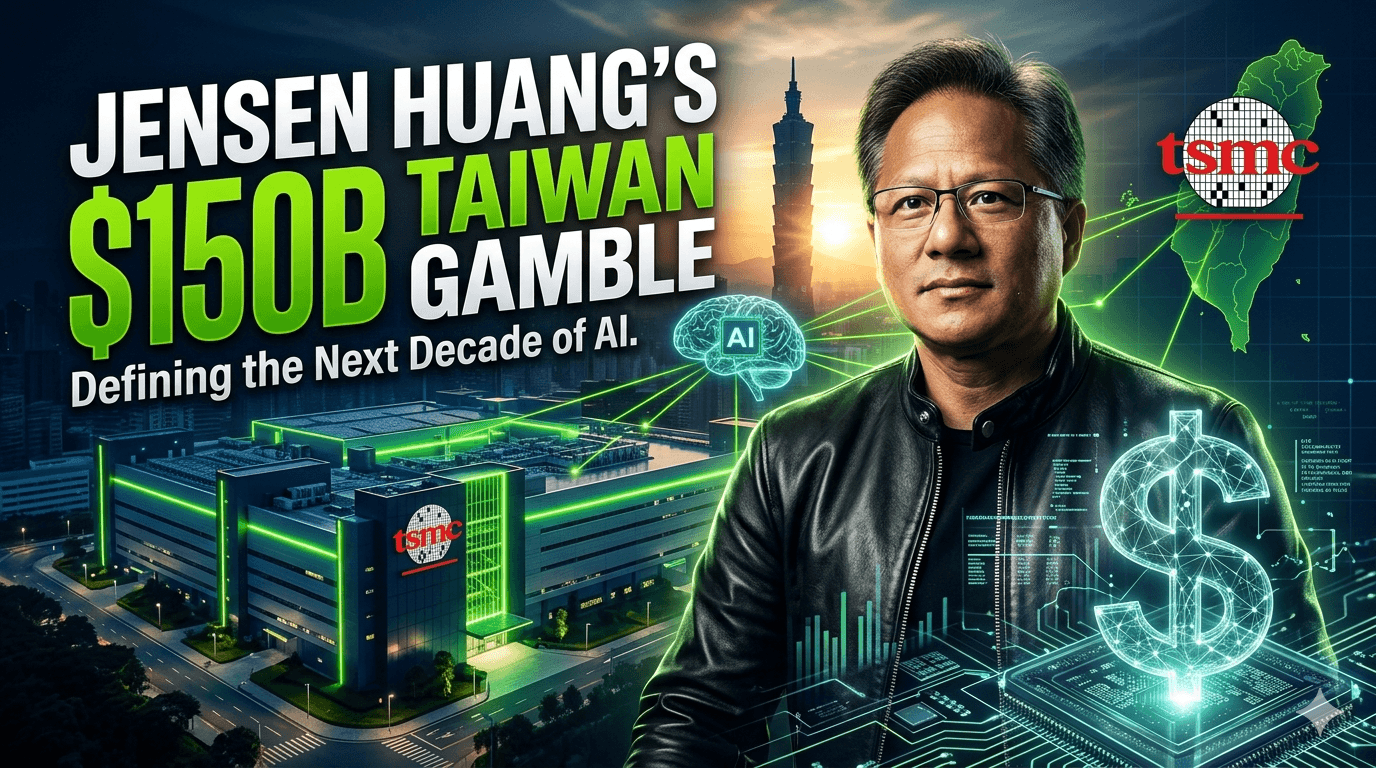
Jensen Huang's $150 Billion Taiwan Gamble Could Define the Next Decade of AI
The numbers are almost too large to process. Nvidia CEO Jensen Huang has announced a $150 billion commitment to AI infrastructure spending in Taiwan over the next four years — the single largest corporate investment pledge in the history of artificial intelligence. This is not a press release. This is a strategic declaration of dominance.
Markets reacted immediately. Taiwan chip stocks surged, NVDA premarket activity spiked, and every competitor from AMD to Intel found themselves re-reading the same headline wondering how to respond. The Nvidia $150 billion Taiwan AI investment isn't a business decision. It's a geopolitical move dressed in a quarterly earnings jacket.
The Announcement That Stopped Markets Cold
Jensen Huang revealed the commitment during a major address that Reuters described as positioning Taiwan as the "epicentre of AI revolution." The $150 billion figure encompasses chip manufacturing contracts, data center buildouts, and deep integration with TSMC — Taiwan Semiconductor Manufacturing Company — the foundry that produces the vast majority of the world's most advanced semiconductors.
Nvidia's H100 and Blackwell GPU architectures, the backbone of virtually every serious AI training operation on Earth, are manufactured in Taiwan. This investment locks that relationship in place for years, possibly decades. CNBC reported Taiwan chip stocks climbing within hours of the announcement.
Why Taiwan? The Strategic Logic Behind the Nvidia $150 Billion Taiwan AI Investment
Taiwan is not simply a manufacturing location. It is the world's most strategically concentrated point of semiconductor production. TSMC alone accounts for over 90% of the world's most advanced chips (3nm and below). For Nvidia, abandoning or diversifying away from Taiwan would mean slower chips, higher costs, and ceding ground to rivals who have no such dependency.
Huang's calculus is clear: double down on the relationship that got you here. By committing $150 billion, Nvidia isn't just securing supply — it's pricing every competitor out of the same access tier. No other fabless chip company can write a check that large.
There's also the talent argument. Taiwan's semiconductor engineering ecosystem is decades deep. The institutional knowledge embedded in TSMC's workforce doesn't transfer easily. Jensen Huang isn't just buying chips — he's buying the irreplaceable human infrastructure that designs and manufactures them.
http://googleusercontent.com/image_collection/image_retrieval/18443508159599386311_0
TSMC's advanced fabs in Taiwan produce the overwhelming majority of Nvidia's GPU architectures — the chips powering every major AI model in operation today.
What $150 Billion Actually Buys
To put $150 billion in context: it is larger than the GDP of Hungary. It is more than the combined annual revenue of Intel, AMD, and Qualcomm in 2024. It is roughly equivalent to building 15 Apollo programs in today's dollars.
Concretely, the investment is expected to cover several categories of spend. Advanced packaging facilities using CoWoS (Chip on Wafer on Substrate) technology — essential for high-bandwidth memory integration in AI chips — require billions per facility. Nvidia's next-generation Rubin GPU architecture, slated for 2026, demands cutting-edge 2nm process nodes that only TSMC can currently deliver.
Data center sovereign infrastructure is another major component. As governments worldwide demand AI compute capacity within their own borders, Nvidia is positioning itself to deploy turnkey AI factories — full-stack systems including networking, storage, and cooling — using chips manufactured exclusively in Taiwan.
The Geopolitical Minefield Nobody Wants to Discuss
The $150 billion commitment lands in one of the world's most volatile geopolitical theatres. Taiwan's relationship with China remains unresolved, and U.S.-China tech tensions have escalated sharply since 2022 export controls restricted Nvidia's ability to sell H100 chips to Chinese buyers.
By deepening its Taiwan dependency, Nvidia is making an implicit geopolitical bet: that Taiwan remains stable, accessible, and protected. This is not an irrational bet — U.S. strategic interest in Taiwan's semiconductor industry is now codified in the CHIPS Act and reinforced by billions in federal support for domestic fab construction. But the risk is real.
Any disruption to Taiwan Strait stability — military posturing, blockade scenarios, or accelerated cross-strait tensions — would affect not just Nvidia's supply chain but the entire global AI buildout. The company's market cap, currently hovering near $3 trillion, is in part a bet that Taiwan's geopolitical status remains quo.
http://googleusercontent.com/image_collection/image_retrieval/13485540939541713029_0
The global AI supply chain flows through a remarkably small number of geographic chokepoints — Taiwan being, by far, the most consequential.
What the Markets Are Saying
NVDA has been the defining stock of the AI era. From $150 in early 2023 to a peak above $140 post-split in 2024 (adjusted), it has delivered returns that redefined what technology investment looks like in a generational cycle. The $150 billion announcement reinforces the bull case: Nvidia is not a chip company. It is an AI infrastructure monopoly with a chip manufacturing arm.
Institutional reaction has been predictable but important. Taiwan Semiconductor (TSM on NYSE) moved positively on the news. Ancillary players in the supply chain — SK Hynix (HBM memory), ASML (EUV lithography), Cadence and Synopsys (EDA software) — all carry secondary exposure to a world where Nvidia's Taiwan commitment entrenches the current supply chain architecture for years.
The short case, by contrast, focuses on execution risk and geopolitical exposure. A $150 billion commitment over four years means roughly $37.5 billion per year in capital obligations — against Nvidia's 2024 annual revenue of approximately $60 billion. The leverage is significant.
Jensen Huang's Strategic Vision: The AI Factory Model
Huang has been consistent in articulating his vision: the world is building "AI factories" — purpose-built compute infrastructure analogous to the electrical grid. Just as no modern economy functions without electricity, Huang argues no modern economy will function without AI compute access.
Taiwan is, in his framing, the Saudi Arabia of this new resource. And Nvidia is both the driller and the refiner. The $150 billion investment in the Nvidia $150 billion Taiwan AI investment framework is Huang locking up the oil fields before anyone else realizes what they're standing on.
This is why the announcement matters beyond the dollar figure. It signals that Nvidia views the next four to six years as the critical window for AI infrastructure buildout — a land-grab phase where the companies that secure manufacturing, data center capacity, and software ecosystems will define the next computing era entirely.
http://googleusercontent.com/image_collection/image_retrieval/8724057502770778122_0
AI infrastructure commitments of this scale ripple through equity markets, bond yields, and supply chain valuations across dozens of adjacent sectors.
The Risks the Bulls Are Ignoring
Three structural risks deserve serious attention.
First, customer concentration. The five largest hyperscalers — Microsoft, Google, Amazon, Meta, and Oracle — account for a disproportionate share of Nvidia's revenue. If even one shifts procurement strategy, builds more custom silicon (as Google has with TPUs and Amazon with Trainium), or slows AI capex in a macro downturn, Nvidia's $150 billion Taiwan commitment becomes a liability rather than an asset.
Second, regulatory risk. The U.S. government has shown increasing willingness to intervene in semiconductor supply chains. Export controls evolve. New restrictions on Taiwan-sourced AI chips could emerge, particularly in response to Chinese escalation or domestic political shifts post-2026 midterms.
Third, the competitive timeline. Nvidia's moat is real but not eternal. AMD's MI300X has captured meaningful share in inference workloads. Startups like Groq, Cerebras, and Tenstorrent are targeting specific AI use cases with custom architectures. Intel's Gaudi 3 remains in the market. A four-year, $150 billion commitment locks Nvidia into a specific technology trajectory. If the architecture of AI compute shifts faster than expected — toward neuromorphic chips, optical computing, or entirely new paradigms — the investment could prove poorly timed.
What This Means for You
The Nvidia $150 billion Taiwan AI investment is the clearest signal yet that the AI infrastructure buildout is not slowing. It is accelerating. This has direct implications for how tech-forward investors and industry observers should position themselves over the next 12 to 24 months.
3 Actions to Take Right Now
- Audit your AI infrastructure exposure. If you hold NVDA directly, understand that this announcement deepens geopolitical concentration risk alongside the upside. Balance NVDA with upstream and downstream supply chain names (TSM, ASML, AMAT) to capture the buildout without single-stock concentration.
- Track the hyperscaler AI capex cycle. Microsoft, Google, and Amazon are publishing quarterly AI infrastructure spend numbers. When those numbers plateau or contract, Nvidia's revenue trajectory will follow. Watch earnings calls for language shifts around "infrastructure optimization" — it's the first indicator of a cycle turn.
- Read the Taiwan risk directly. Subscribe to the Rhodium Group, CSIS, or Brookings Institution for regular Taiwan Strait security analysis. If you have meaningful technology sector exposure, this is no longer optional geopolitical reading — it is core portfolio risk management.
Related Articles

Benedict Evans Says Most Enterprise AI Spend Is Wasted — Here's What Actually Works

How To Disable AI Mode On Google (And Stop Overpaying On Search)

Ed Zitron Called the AI Bubble Two Years Ago. Dan Luu Just Checked His Math.