Google Antigravity 2.0: The Agent Platform That's Rewriting How Software Gets Built
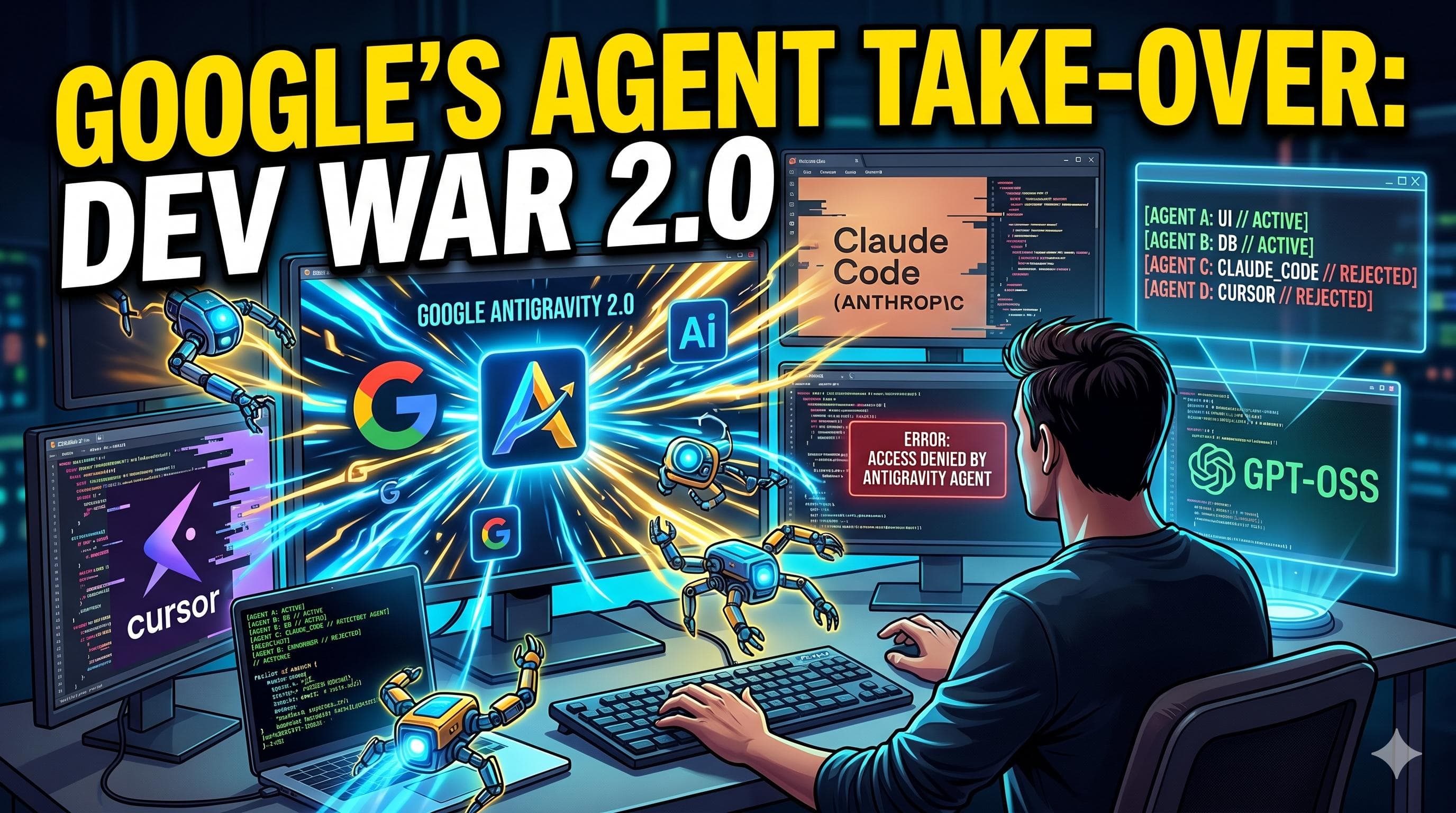
Google Antigravity 2.0: The Agent Platform That's Rewriting How Software Gets Built
By AI Architecture & Development Desk
~1,400 words · Reading Time: 7 minutes

The Keynote Signal Nobody Should Miss
Google I/O 2026 was not a traditional product announcement event. It was, for all intents and purposes, a declaration of war on the existing developer stack. On May 19, 2026, Google's engineering leadership didn't merely introduce new features—they inaugurated a fundamentally new paradigm: agent-first development.
Antigravity 2.0, Gemini 3.5 Flash, Managed Agents in the Gemini API, and a proposed open web standard called WebMCP arrived simultaneously. If you missed the keynote, you missed a seismic shift that will define the next three years of software engineering.
The previous iteration of Antigravity was a capable, albeit narrowly-scoped, AI coding assistant. It lived in your editor and offered suggestions. The 2.0 release transforms it into a standalone desktop application that orchestrates multiple autonomous AI agents in parallel. Imagine one agent scaffolding your frontend React components, another writing and executing your backend Python integration tests, and a third generating necessary brand assets—all communicating seamlessly, without a human in the loop.
Google's framing has irrevocably changed. The question developers must ask is no longer, "How smart is the model?" It is now, "How much can the model execute without my intervention?"
From Copilot to Autonomous Workspace: What Is Antigravity 2.0?

Antigravity 2.0 is Google's masterclass in agent-first development, rebuilt entirely from the ground up. At its core, it is a multi-agent orchestration environment—a digital war room where developers spin up specialized sub-agents to tackle complex workflows simultaneously. Where the original Antigravity augmented a developer's typing speed, the new version seeks to replace entire cognitive task loops.
The platform ships with features that prove Google is targeting serious enterprise adoption:
| Feature | Description | |---|---| | 🔒 Cross-platform terminal sandboxing | Agents execute code safely without risking the host machine | | 🔑 Native credential masking | API keys and sensitive variables are automatically obscured | | 🌿 Hardened Git policies | Branch protections and automated PR reviews enforced before any commit |
All sub-agent activity is deeply protected and auditable. This is a direct, calculated response to the lingering enterprise anxieties about autonomous AI touching production environments. Google isn't just selling intelligence; they are selling the guardrails required to use it safely.
Three Surfaces, One Ecosystem
Google shipped three distinct interaction surfaces for the Antigravity ecosystem, each meticulously tailored to a different segment of the developer market:
🖥️ Antigravity 2.0 Desktop App
The flagship visual product. Here, developers transition from coders to conductors. You instruct parallel sub-agents visually—watching Agent A patch a UI bug while Agent B concurrently provisions the necessary database tables. Complex, multi-stage workflows that previously required days of sequential labor now execute in minutes.
⌨️ Antigravity CLI
A lightweight, terminal-native harness. This allows engineers to spin up, monitor, and kill agent processes directly from the command line with zero graphical overhead. Built strictly for high-velocity engineers who refuse to leave their terminal multiplexers.
🔧 Antigravity SDK
The enterprise integration layer. This offers programmatic access to the exact same agent harness powering Google's internal tools. Crucially, while optimized for Gemini, it is not exclusive to it. Confirmed initial support includes Anthropic's Claude 3.5 Sonnet and OpenAI's GPT-OSS models. This is a deliberate, confident signal from Mountain View: We are competing on the quality of our orchestration environment, not relying on model lock-in.
The Engine of the Shift: Gemini 3.5 Flash & Agentic Economics

Antigravity 2.0's beating heart is Gemini 3.5 Flash, the pioneer of Google's new 3.5 model lineage. According to DeepMind Chief Technologist Koray Kavukcuoglu:
"3.5 Flash offers an incredible combination of quality and low latency. It outperforms our latest frontier model, 3.1 Pro, on nearly all benchmarks, while running four times faster than competing frontier models."
This combination—frontier-level reasoning at "Flash" speeds—is what makes multi-agent parallel execution economically viable.
Pricing
| Token Type | Price | |---|---| | Input | $1.50 / million tokens | | Output | $9.00 / million tokens |
For high-volume, lower-stakes agentic pipelines (where models might "think" through thousands of lines of logs to find a bug), this cost structure is disruptive.
In leaked internal tests, a swarm of 3.5 Flash agents reportedly built a functional micro-operating system from scratch. The agents pause only at critical permission barriers or architectural crossroads that fundamentally require human judgment.
AI Studio: The Prototyping Sandbox Goes Pro
I/O 2026 also delivered substantive upgrades to Google AI Studio, transforming it from an API playground into a production-grade pipeline:
- Native Kotlin support enables "vibe coding" for Android apps directly within the browser
- One-click Cloud Run deployment compresses the journey from prototype to scalable production into a single mouse click
- Google Workspace integration empowers developers to build tools that natively interact with live Sheets, Drive files, and Docs
But the true masterpiece is the new "Export to Antigravity" button. This acts as the critical connective tissue: it packages an entire AI Studio workspace (system prompts, chat histories, mocked file trees, and active context tokens) and hands the fully hydrated context directly to your local Antigravity 2.0 desktop environment.
The gap between a web-based prototype and a multi-agent local production execution has been reduced to zero.
WebMCP: The Sleeper Hit That Rewires the Internet
While the shiny desktop apps garnered the applause, the most underreported announcement at I/O 2026 carries the heaviest long-term implications. Google proposed WebMCP (Web Machine Context Protocol)—an open standard for browser-based AI agents.
Currently, AI models interact with the web through fragile screen-scraping techniques or walled-garden proprietary APIs. WebMCP allows agents to interact with web content natively through Chrome, using a standardized, machine-readable protocol.
If adopted broadly, WebMCP changes the architecture of the internet.
The Full I/O 2026 Stack
┌─────────────────────────────────────────────────────────┐
│               Google's Agentic Supply Chain             │
├─────────────────────────────────────────────────────────┤
│  🧠  Gemini 3.5 Flash     →  Intelligence Layer         │
│  ⚙️  Antigravity 2.0      →  Orchestration Environment  │
│  ☁️  Firebase & Cloud Run →  Deployment & Backend       │
│  🌐  WebMCP               →  Universal Web Interface    │
└─────────────────────────────────────────────────────────┘
Google is not merely adding features to a roadmap. They have built a complete, vertically integrated supply chain for agentic software development.
The Agent IDE War Has Begun

Antigravity 2.0's entry at scale fundamentally alters the competitive dynamics across all developer tools. Incumbents like Claude Code (Anthropic), Cursor, and Windsurf now face a deeply resourced apex predator—one that seamlessly bundles model infrastructure, cloud services, and a massive existing development ecosystem.
The agent IDE market, valued at approximately $2.3B in 2025, is now projected to exceed $11B by 2028.
However, Google's launch was not without its scars. The forced, automatic update that legacy Antigravity 1.x users experienced during the keynote—which inadvertently overwrote working environments without rollback options—generated severe backlash on HackerNews and X.
That said, the macroeconomic pressure is structurally beneficial for the end-user. The brutal competition between Claude Code, Cursor, Windsurf, and Antigravity guarantees that all platforms will iterate faster, price more aggressively, and push the boundaries of what is possible.
The Human Element: From Typist to Director
Beyond the technical specifications and competitive posturing, Antigravity 2.0 forces a philosophical reckoning for the software engineering profession.
There is an undeniable, quiet anxiety humming beneath the excitement. As developers, our identities have long been tied to the mastery of syntax, the elegance of our loops, and our ability to hold complex architectures in our minds. When an agent can write a test suite in three seconds, what is our value?
The answer provided by Antigravity 2.0 is both demanding and liberating:
Your value is no longer in the typing; it is in the directing.
We are transitioning from solo instrumentalists to orchestra conductors. The friction of translating human thought into machine code is dissolving. What remains is the pure, unadulterated challenge of solving human problems. The engineers who will thrive in this new era are those who excel at:
- System design
- Product empathy
- Orchestrating complex digital teams
You are no longer just a coder; you are a technical manager of an infinitely scalable, tireless digital agency.
The Blueprint for 2026 and Beyond
Google I/O 2026 will be remembered as the moment the agent-first era officially matured from experimental scripts into enterprise-grade infrastructure.
Antigravity 2.0 is not perfect. It will hallucinate, it will occasionally misconfigure a Git branch, and it will require humans to clean up its more ambitious messes. But by combining the blistering speed of Gemini 3.5 Flash with a robust, sandboxed orchestration environment and the visionary WebMCP protocol, Google has drawn a definitive line in the sand.
The tools to build the future of software are no longer just waiting for your input.
They are waiting for your command.
© AI Architecture & Development Desk · May 2026
Related Articles
Benedict Evans Says Most Enterprise AI Spend Is Wasted — Here's What Actually Works

How To Disable AI Mode On Google (And Stop Overpaying On Search)
Ed Zitron Called the AI Bubble Two Years Ago. Dan Luu Just Checked His Math.